
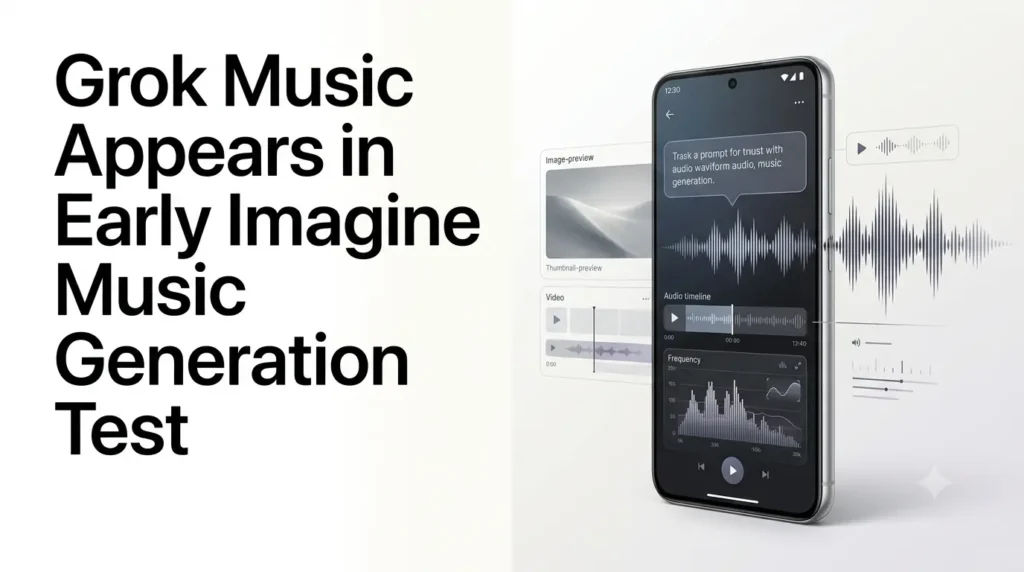
xAI appears to be testing Grok Music generation inside Grok Imagine, according to an early Android preview shared on September 26, 2026. The preview reportedly shows users generating music from prompts, suggesting that Imagine could eventually expand beyond its existing image and video capabilities into standalone AI music creation.
However, the feature has not been officially announced by xAI. The company’s current Imagine documentation covers image generation, image editing, video generation and video editing, while its published information about Grok Imagine Video 1.5 describes generated audio in the form of sound effects, ambience and dialogue for videos.
That makes the Android preview significant as a potential early look at an unreleased capability, but not confirmation that Grok Music is generally available.
Quick Summary
- xAI appears to be testing Grok Music inside its Imagine experience.
- The early preview was reportedly seen on Android.
- The feature appears capable of generating music from text prompts.
- It is still an early test, rather than a confirmed public launch.
- xAI’s official Imagine documentation currently focuses on image and video generation.
- Grok Imagine already supports generated sound effects, ambience and dialogue for video.
- xAI has not yet confirmed Grok Music’s model, pricing, availability, track length or commercial-use rights.
What the Grok Music Preview Shows?
The early preview shared by an X user identifies the feature as Grok Music and shows it being tested inside the Imagine experience on Android. The post describes the system as capable of producing different kinds of tracks from prompts and says the interface required additional changes to open the feature, indicating that the experience was not a standard public release.
A separate report tracking the preview also identifies the footage as an early Android test and notes that the public evidence does not establish whether the capability is an internal build, limited experiment or feature being prepared for wider availability.
That distinction is important because the available evidence does not yet establish several basic product details, including the underlying music model, maximum track length, vocal generation, editing controls, export formats, licensing terms or commercial-use rights.
In other words, the current development is better described as an apparent Grok Music test than a formal product launch.
How Grok Music Would Expand Grok Imagine?
Grok Imagine is already positioned as xAI’s creative-generation environment. The platform currently supports image and video generation, with xAI’s documentation describing text-to-image, image editing, text-to-video and image-to-video workflows.
The addition of standalone music generation would broaden that workflow considerably.
Instead of using Imagine primarily to create visual assets, users could potentially generate multiple components of a media project within the same ecosystem:
- Images generated from text prompts
- Videos created from text or images
- Generated audio for video
- Potentially standalone music tracks
- Potentially music designed around a particular creative prompt
The last two capabilities remain unconfirmed because xAI has not yet documented them in its public Imagine materials.
The direction would nevertheless be consistent with the broader evolution of generative AI tools toward multimodal creative workflows, where users can produce different forms of media without moving between separate applications.
Grok Imagine Already Generates Audio for Video
There is an important distinction between audio generation for video and standalone AI music generation.
When xAI released Grok Imagine Video 1.5 in June 2026, it said the model could generate sound effects, ambience and dialogue in the same pass as the video. The company also described improvements to audio synchronization alongside improvements in motion and physics.
The current xAI developer documentation likewise describes Grok Imagine Video 1.5 as a video-generation model with generated audio. Users can generate video from text or image references, with configurable duration and resolution.
That existing capability provides a foundation for understanding why music generation could fit naturally into Imagine. But it should not be conflated with a dedicated text-to-music system.
A standalone music generator would need to handle musical structure and potentially elements such as instrumentation, vocals, lyrics, genre, duration and editing in ways that differ from generating audio synchronized to a video.
None of those capabilities have been officially documented for Grok Music at this stage.
What Remains Unknown About Grok Music?
The early preview leaves several important questions unanswered.
1. Music model and generation capabilities
xAI has not publicly identified a dedicated Grok Music model or published technical documentation explaining how the reported music generation works.
It is therefore not possible to independently establish from the current public documentation whether the capability uses a dedicated music-generation architecture, an extension of an existing Imagine system or another approach.
2. Track length and controls
The preview does not establish how long generated tracks can be, whether users can extend or remix them, or whether the system supports structured controls for instruments, vocals, tempo or musical sections.
Those details would be important for distinguishing a simple audio-generation experiment from a full AI music-production tool.
3. Availability
The most significant limitation is availability.
The evidence currently points to an early Android preview, rather than a public feature available to all Grok users. The X post itself describes the experience as a very early look and notes that additional modifications were required to access it.
xAI’s official Imagine documentation does not currently list Grok Music as an available capability.
Grok Music Would Enter an Established AI Music Market
If xAI eventually releases standalone music generation through Grok Imagine, it would enter a category already served by dedicated AI music platforms.
Products such as Suno and Udio have focused specifically on prompt-driven music creation, giving users tools for generating songs and working with musical compositions. A Grok implementation would therefore be entering a more specialized market than the image and video generation categories where Imagine is already established.
The potential distinction for xAI would be integration.
Rather than requiring a creator to generate an image, video and soundtrack using separate services, Imagine could eventually bring multiple media-generation workflows together. That could be particularly relevant for users creating short-form video or other multimedia content.
But this remains a potential use case rather than a demonstrated feature of the current preview.
What xAI Officially Offers in Imagine Today?
For now, xAI’s documented Imagine capabilities remain focused on visual generation.
The company’s current documentation lists Grok Imagine Image 2.0 for image generation and editing, including natural-language editing and support for reference images. It also lists Grok Imagine Video 1.5 for video generation from text or image references.
xAI’s official Imagine API similarly describes image and video generation, editing and related creative workflows.
This makes the reported Grok Music preview notable precisely because it appears to extend the scope of Imagine beyond the capabilities currently documented by the company.
For now, however, the distinction between an experimental capability and an announced product remains important.
If the feature moves beyond testing, additional information from xAI would be needed to confirm its official name, supported platforms, model architecture, availability, pricing, generation limits and rights associated with generated music.
Until then, the available evidence points to an early Grok Music experiment on Android, rather than a confirmed public launch. xAI’s official Imagine platform remains centered on image and video generation, with audio already supported as part of video generation.
Also Read –
Grok Imagine: Turn Photos Into Videos on X Using AI
Grok Imagine Image 2.0 + Video 1.5: Complete Creative Workflow Guide
Grok Imagine Video 1.5: Features, Speed, Audio, Limits & Real-World Performance