
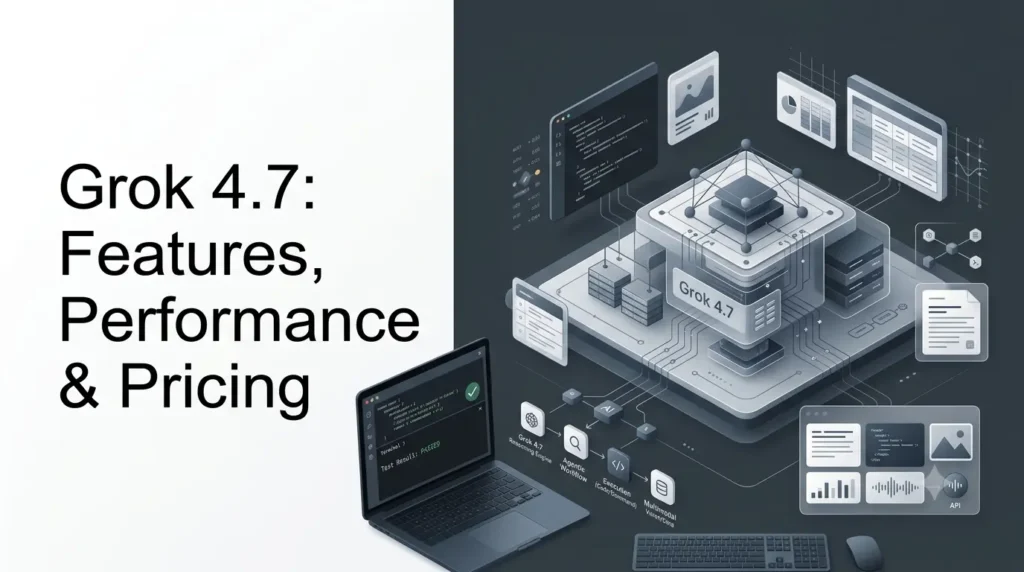
Grok 4.7 is the latest AI model from SpaceXAI, released on September 21, 2026 with a focus on coding, long-running agentic tasks, and professional knowledge work. It succeeds Grok 4.6 with a larger base model, longer reinforcement-learning training, stronger self-verification, improved long-context handling, and a new safeguard stack.
The model is available today through Grok Build, the Grok API, Cursor, third-party coding harnesses, model routers, and cloud platforms. SpaceXAI says Grok 4.7 is served at the same price and speed as Grok 4.6, with API pricing starting at $2 per million input tokens and $6 per million output tokens. A faster variant is also available at twice the price and twice the output speed.
At launch, the biggest change is not simply a higher benchmark score. Grok 4.7 has been trained specifically for tasks that can take hours rather than minutes, with an emphasis on continuing work, checking results, managing longer context, and recovering from mistakes.
Quick Summary
- Grok 4.7 is SpaceXAI’s latest AI model focused on coding and knowledge work.
- It uses a larger base model and longer reinforcement learning for complex tasks.
- New capabilities improve self-verification, reasoning, and long-context task management.
- Grok 4.7 is designed to work more effectively with Grok Bot and AI-agent workflows.
- It delivers stronger results in coding, research, documents, presentations, and professional tasks.
- Official benchmarks show improvements over Grok 4.6 across several coding and knowledge-work evaluations.
- API pricing starts at $2 per million input tokens and $6 per million output tokens.
- Grok 4.7 is available through Grok Build, Cursor, the Grok API, and selected third-party platforms.
- SpaceXAI also introduced a new safeguard stack focused on improving safety and resistance to jailbreaks.
What s Grok 4.7?
Grok 4.7 is SpaceXAI’s newest model for coding and knowledge work. It is a successor to Grok 4.6 and uses a new, larger base model combined with a longer reinforcement-learning training process focused on difficult, multi-step tasks.
The model is designed to improve several areas:
- Long-running coding tasks
- Software engineering
- Agentic workflows
- Document creation
- Presentations
- Research and knowledge work
- Tool-based tasks
- Self-verification
- Long-context work
- Cybersecurity
- Professional workflows
- Interactive applications
SpaceXAI also trained Grok 4.7 to understand the Grok Bot harness natively, which is intended to improve its ability to operate in agentic environments rather than functioning only as a conventional conversational model.
The release therefore continues the direction established with Grok 4.6, but puts greater emphasis on sustained execution and reliability across longer tasks.
What Is New in Grok 4.7?
The most important improvements over Grok 4.6 are related to how the model handles difficult tasks over time.
1. Larger Base Model
SpaceXAI says Grok 4.7 uses a new, larger base model compared with Grok 4.6.
The company has not publicly specified the total parameter count or active parameter count in its launch announcement. Therefore, claims about the exact size of Grok 4.7 should not be treated as confirmed specifications.
What SpaceXAI does confirm is that the model architecture and training setup have been expanded to support more demanding workloads.
2. Longer Reinforcement Learning
One of the central changes is a longer reinforcement-learning run.
Instead of focusing primarily on short benchmark-style tasks, SpaceXAI says the training mix was weighted toward problems that can require many hours to complete.
This is important for agentic AI because a model working on a software project may need to:
- Understand the objective.
- Inspect an existing codebase.
- Plan an implementation.
- Modify multiple files.
- Run tests.
- Analyze failures.
- Change the implementation.
- Run the tests again.
- Review the final result.
A model can be excellent at generating individual code snippets while still struggling with this type of extended workflow.
Grok 4.7 is specifically trained to perform better at the latter.
3. Better Self-Verification
Grok 4.7 is designed to check its own work more carefully.
This does not mean the model is guaranteed to produce correct results. Instead, the training objective places more emphasis on identifying errors and verifying intermediate work before completing a task.
That distinction matters for coding and professional workflows because an agent may produce a plausible answer while missing a broken dependency, failed test, incorrect calculation, or incomplete requirement.
4. Improved Long-Context Management
SpaceXAI says Grok 4.7 is better at managing longer context.
The company has not announced a new numerical context-window specification in the launch announcement, so it is better not to describe Grok 4.7 as having a specific context limit unless SpaceXAI publishes one.
The practical goal is clearer: the model is intended to maintain and use information more effectively during longer-running tasks.
5. Native Grok Bot Harness Understanding
Another significant change is that Grok 4.7 was trained to natively understand the Grok Bot harness.
Grok Bot is SpaceXAI’s persistent-agent system. Bots can operate with their own cloud computer and interact with applications and websites to complete delegated tasks.
Training Grok 4.7 specifically for this environment is important because it connects the model to a broader agentic ecosystem.
Instead of simply answering:
“How do I do this?”
The model can increasingly be used in systems designed to actually perform the work.
Grok 4.7 Performance: How Much Better Is It?
SpaceXAI published several benchmark comparisons between Grok 4.7 and Grok 4.6.
| Benchmark | Grok 4.7 | Grok 4.6 | Change |
|---|---|---|---|
| CursorBench 4.0 | 46.3% | 40.4% | +5.9 points |
| DeepSWE v1.1 | 71.0%* | 65.2% | +5.8 points |
| AA Briefcase v1.1 | 1,657 | 1,546 | +111 |
| Terminal-Bench 4.0 | 38.0% | 20.3% | +17.7 points |
| Harvey Legal Agent Benchmark | 19.6% | 15.8% | +3.8 points |
| HealthBench Professional | 56.7% | 48.5% | +8.2 points |
| EEBench | 64.0% | 53.0% | +11 points |
SpaceXAI marks the Grok 4.7 DeepSWE result as a high-effort score.
These figures come from SpaceXAI’s own launch evaluation. They should therefore be treated as vendor-reported benchmark results, not as a universal ranking of AI models.
There is also an important methodological detail: the published table compares Grok 4.7 xhigh against Grok 4.6 high. That means the benchmark results are not simply a test of the two models at identical reasoning-effort settings. Readers comparing the numbers should keep this difference in mind.
CursorBench 4.0
Grok 4.7 scores 46.3% on CursorBench 4.0 compared with 40.4% for Grok 4.6.
CursorBench is particularly relevant because it focuses on longer-running software engineering work.
The improvement supports SpaceXAI’s claim that the new model is designed for more sustained coding tasks rather than only short code-generation prompts.
Terminal-Bench 4.0
The difference is larger on Terminal-Bench 4.0:
- Grok 4.7: 38.0%
- Grok 4.6: 20.3%
That is a 17.7-percentage-point difference in SpaceXAI’s reported evaluation.
Terminal-style tasks are useful for evaluating agents because the model must work through a computer environment instead of simply returning an answer.
DeepSWE v1.1
Grok 4.7 records 71.0% on DeepSWE v1.1 in SpaceXAI’s high-effort configuration, compared with 65.2% for Grok 4.6.
Again, the high-effort qualification matters when interpreting the result.
Grok 4.7 for Coding
Coding is one of the main targets of the new model.
Grok 4.7 is designed for software engineering tasks that involve more than generating isolated functions.
Potential workloads include:
- Building features
- Debugging
- Refactoring
- Testing
- Working through terminal environments
- Modifying existing repositories
- Reviewing implementations
- Creating documentation
- Developing interactive applications
- Working with coding agents
The emphasis on longer-running tasks makes Grok 4.7 particularly relevant to coding environments such as Cursor and Grok Build.
Cursor confirmed that Grok 4.7 is available in its platform from launch day.
SpaceXAI also makes the model available through third-party coding harnesses and model routers.
Grok 4.7 and AI Agents
Agentic AI is arguably the most important context for understanding this release.
A traditional language model generally follows a request-response pattern:
Prompt → Model → Answer
An agentic workflow is more like:
Goal → Plan → Tool use → Action → Observation → Verification → Next action
Grok 4.7 has been optimized for the second type of workflow.
This aligns with SpaceXAI’s broader development of Grok Bot, which gives AI agents persistent environments where they can operate tools and applications.
Grok Bot’s enterprise version provides access, network and audit controls for organizations managing agents at scale.
This means Grok 4.7 is not being developed in isolation. It is part of a wider push toward AI systems that can take responsibility for multi-step work.
Grok 4.7 for Documents and Presentations
Grok 4.7 is also designed for professional knowledge work.
SpaceXAI says the model performs better at creating:
- Documents
- Presentations
- Research outputs
- Professional reports
- Structured knowledge-work deliverables
The company evaluated Grok 4.7 on GDPval and AA Briefcase, benchmarks involving tasks associated with professional occupations such as law, nursing and financial analysis.
This expands the model’s intended use beyond software engineering.
A useful distinction is that Grok 4.7 is not being positioned simply as a coding model. Coding is one major capability, while professional knowledge work is the broader category.
Grok 4.7 for Research and Knowledge Work
Grok 4.7 can also be used for research-oriented tasks where an agent needs to work through information over an extended period.
Potential applications include:
- Research synthesis
- Document analysis
- Technical research
- Market research
- Data interpretation
- Report creation
- Multi-step investigation
- Information organization
The value of the model in these situations comes less from producing a single polished paragraph and more from its ability to maintain a longer workflow and verify intermediate results.
For high-stakes research, however, users should still verify important claims against primary sources.
Grok 4.7 Safety and Cybersecurity
SpaceXAI says Grok 4.7 was built with an entirely new safeguard stack.
The company reports that it achieved its strongest results to date on refusal and jailbreak-resistance testing.
For dual-use areas such as cybersecurity and biological research, SpaceXAI says it aimed to balance useful defensive capabilities with restrictions on dangerous requests.
On its published evaluations:
- LatchBio biosafety benchmark: 62.4%
- HackerBench v0.3: 3.3% of risky dual-use prompts allowed through
These figures are SpaceXAI-reported results and should be interpreted according to the specific benchmark definitions rather than as a general safety guarantee.
SpaceXAI also says selected cybersecurity partners have received invite-only access to Grok 4.7 red-team capabilities for defensive research.
Grok 4.7 vs Grok 4.6
The difference between the two models can be summarized as a shift toward longer, more demanding work.
| Feature | Grok 4.6 | Grok 4.7 |
|---|---|---|
| Release | August 2026 | September 21, 2026 |
| Primary focus | Coding, agents and knowledge work | Coding, agents and extended knowledge work |
| Base model | Previous generation | New, larger base model |
| Reinforcement learning | Earlier training setup | Longer RL run on harder, longer tasks |
| Self-verification | Supported | Improved |
| Long-context management | Strong | Improved |
| Grok Bot harness | Existing ecosystem | Native training emphasis |
| Coding | Yes | Improved |
| Agentic tasks | Yes | Stronger focus |
| Documents/presentations | Yes | Improved |
| Safety stack | Existing | New safeguard stack |
| API price | $2 input / $6 output | $2 input / $6 output |
The most important point is that Grok 4.7 does not introduce a higher API price than Grok 4.6. SpaceXAI explicitly says it is served at the same price and speed as 4.6.
Grok 4.7 Pricing
API Pricing
Grok 4.7 starts at:
| Usage | Price per 1 million tokens |
|---|---|
| Input | $2 |
| Output | $6 |
SpaceXAI says the standard Grok 4.7 model is served at the same price and speed as Grok 4.6.
A faster Grok 4.7 variant is also available at twice the output speed and twice the price.
Based on the launch pricing, that corresponds to:
| Variant | Input | Output |
|---|---|---|
| Grok 4.7 | $2 / 1M | $6 / 1M |
| Grok 4.7 Fast | $4 / 1M | $12 / 1M |
The regular model’s pricing is explicitly stated by SpaceXAI; the fast variant’s doubled pricing follows the company’s statement that it costs twice as much.
Is Grok 4.7 Included With SuperGrok?
This requires some caution because the consumer pricing page has not yet been fully updated to list Grok 4.7.
The current SpaceXAI pricing page lists:
- Free — $0/month
- SuperGrok — $30/month
- SuperGrok Plus — $100/month
The page currently identifies Grok 4.6 as the listed model for these consumer plans.
At the same time, SpaceXAI’s Grok 4.7 launch announcement says the model is available today through Grok Build, the API, Cursor, third-party coding harnesses, model routers and cloud platforms.
Therefore, it is better not to state that a particular SuperGrok subscription definitely includes Grok 4.7 until SpaceXAI updates its consumer plan documentation.
Where Can You Use Grok 4.7?
At launch, SpaceXAI says Grok 4.7 is available through:
- Grok Build
- Grok API
- Cursor
- Third-party coding harnesses
- Model routers
- Cloud platforms
Cursor separately confirmed the model’s availability on September 21.
For developers, the xAI API uses an OpenAI-compatible REST interface. The current API documentation lists the base URL as:
https://api.x.ai
and supports resources including responses, chat completions, images, videos, voice, files, batches and models.
Grok 4.7 API for Developers
Developers can integrate Grok through the xAI API rather than using the consumer Grok interface.
The API supports several types of workloads, including:
- Text generation
- Reasoning
- Tool calling
- Image generation
- Video generation
- Voice
- File processing
- Search
- Batch processing
The API is compatible with the OpenAI REST API, making it easier for developers already using OpenAI-compatible application architectures to adapt their integrations.
Developers should check the live xAI model documentation before deploying production workloads because model identifiers, pricing and availability can change.
How Does Grok 4.7 Fit Into Grok Bot?
Grok Bot is important to the Grok 4.7 story because the model was specifically trained to understand its harness.
Grok Bot is designed around persistent AI workers that can operate on a cloud computer and interact with websites and applications.
Instead of repeatedly giving an AI assistant instructions, a user can delegate a job to a Bot and allow it to continue working.
SpaceXAI describes the system as having Bots that can work independently and return when the job is finished or when they need a decision.
This is one reason Grok 4.7’s emphasis on longer-running tasks matters. The model is being developed alongside an environment in which sustained autonomous execution is a core product feature.
Grok 4.7 vs Other AI Models
SpaceXAI’s launch announcement compares Grok 4.7 with other frontier systems on several benchmarks.
However, benchmark comparisons require caution because models may be evaluated at different reasoning-effort settings, using different harnesses or under different test conditions.
For Grok 4.7 versus Grok 4.6 specifically, the published table uses:
- Grok 4.7 xhigh
- Grok 4.6 high
Therefore, the benchmark results should not be interpreted as a perfectly controlled apples-to-apples test.
For users, the more practical question is often cost per successfully completed task, especially for coding agents. A model that costs more per token can still be economical if it completes difficult jobs with fewer retries, while a cheaper model can become expensive if it repeatedly fails.
What Are the Limitations of Grok 4.7?
Grok 4.7’s release materials highlight substantial improvements, but there are still important limitations.
1. Benchmark scores are not universal performance measurements
A model’s performance varies by task, prompt, tool environment and reasoning effort.
The published benchmark results come from SpaceXAI and should be treated as evidence about those particular evaluations rather than a guarantee for every workload.
2. Agentic workflows can still fail
Long-running agents introduce additional failure points.
A model can misunderstand the objective, select the wrong tool, make an incorrect change, or continue from a mistaken assumption.
Self-verification can reduce these problems, but it does not eliminate them.
3. Exact model specifications are limited
SpaceXAI has not publicly disclosed an exact parameter count for Grok 4.7 in its launch announcement.
Claims about the model having a specific number of parameters should therefore be treated as unverified unless SpaceXAI publishes those specifications.
4. Consumer availability is still being updated
The current consumer pricing page still lists Grok 4.6, while the Grok 4.7 announcement confirms availability through Grok Build and other developer and coding environments.
This suggests that some consumer-facing documentation may take time to catch up with the model release.
Who Should Use Grok 4.7?
Grok 4.7 is particularly relevant for users who need more than short conversational answers.
Developers
Useful for:
- Software development
- Debugging
- Refactoring
- Code review
- Long-running coding agents
- Terminal workflows
AI Agent Builders
The model’s training around the Grok Bot harness makes it relevant to applications where AI needs to use tools and operate autonomously.
Researchers
Long-context and extended reasoning capabilities can be useful for research workflows, provided important information is independently verified.
Business Users
The model’s focus on documents, presentations and professional knowledge work makes it relevant to business workflows.
Security Professionals
Grok 4.7’s published cybersecurity evaluations and defensive-agent positioning make it relevant to security research, subject to appropriate safety and authorization controls.
What Makes Grok 4.7 Different From Grok 4.6?
The simplest way to understand the upgrade is:
Grok 4.6 → Grok 4.7 = better sustained execution rather than simply a larger benchmark number.
The new model is designed around several related improvements:
Larger base model + longer RL training + better self-verification + stronger long-context management + native Grok Bot harness understanding
Together, these changes target the type of work where an AI system has to keep going after its first answer.
That is especially important for coding agents and professional workflows where the final result may require dozens or hundreds of intermediate decisions.
Conclusion
Grok 4.7 is a substantial evolution of Grok’s agentic direction, with its biggest improvements aimed at long-running coding and knowledge-work tasks.
Rather than focusing only on faster answers or higher short-form benchmark scores, SpaceXAI has trained the model to work through difficult problems for longer, verify its output more carefully, manage extended context and operate more naturally within the Grok Bot agent environment.
Its published results show improvements over Grok 4.6 across coding, terminal work, professional knowledge tasks, legal work, health reasoning and electrical engineering benchmarks. The API also keeps the same $2 input / $6 output per million-token pricing used for Grok 4.6, while a faster variant is offered at twice the price.
For developers, the combination of Grok 4.7, the xAI API, Grok Build, Cursor and Grok Bot makes the release particularly relevant to the broader move from conversational AI toward systems that can actually execute multi-step work.
Because the model launched only on September 21, 2026, independent real-world testing is still limited. SpaceXAI’s benchmark results provide an initial picture of the model’s capabilities, but longer-term performance across different applications will become clearer as developers use it in production.
Frequently Asked Questions
1. What is Grok 4.7?
Grok 4.7 is SpaceXAI’s latest AI model for coding and knowledge work, released on September 21, 2026. It introduces a larger base model, longer reinforcement-learning training, improved self-verification, better long-context management and a new safeguard stack.
2. Is Grok 4.7 better than Grok 4.6?
SpaceXAI reports improvements over Grok 4.6 across all of the benchmarks included in its launch comparison. For example, CursorBench 4.0 increased from 40.4% to 46.3%, while Terminal-Bench 4.0 increased from 20.3% to 38.0%. However, the published comparison uses different reasoning-effort settings, so the figures should be interpreted with that limitation in mind.
3. How much does Grok 4.7 cost?
The Grok 4.7 API starts at $2 per million input tokens and $6 per million output tokens. SpaceXAI also offers a faster version at twice the price and twice the output speed.
4. Is Grok 4.7 available for free?
SpaceXAI says Grok 4.7 is available through Grok Build, and the launch page provides a free-start option. However, access through consumer Grok subscriptions and usage limits should be checked against the latest plan documentation because the current public pricing page still lists Grok 4.6.
5. Where can I use Grok 4.7?
Grok 4.7 is available through Grok Build, the Grok API, Cursor, third-party coding harnesses, model routers and cloud platforms.
7. What is Grok 4.7 mainly designed for?
The model is primarily aimed at coding, software engineering, AI agents and professional knowledge work. It is also designed for document creation, presentations, research, cybersecurity and other long-running tasks.
Also Read –
Grok 4.6 AI Guide: Everything About Its Features, Pricing, Benchmarks and Availability
SuperGrok Pricing & Features: A Complete Guide (2026)
Grok AI Models: Ultimate Comparison Every Model Explained
Build with Grok API: Pricing, Free Credits, and Complete Tutorial