
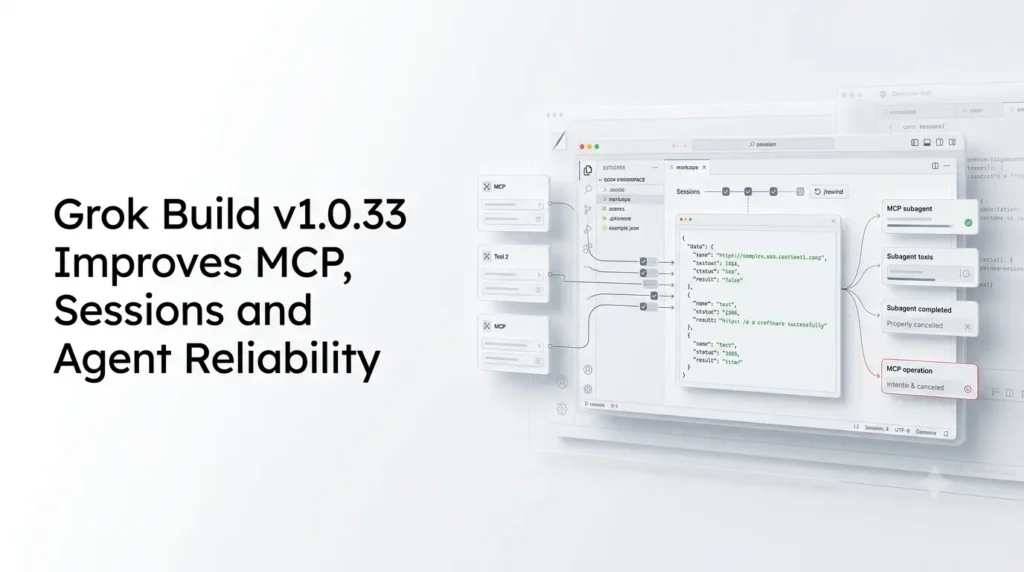
xAI has released Grok Build v1.0.33, a software update for its coding agent that focuses on MCP tool handling, long-running sessions, context management and agent reliability. The release, published September 15, 2026, includes structured JSON data for MCP tool results, improved cancellation behavior and fixes for session checkpoints, subagents and large skill files.
The update is part of a rapid sequence of Grok Build releases aimed at making the coding agent more dependable during extended development workflows. xAI followed v1.0.33 with Grok Build v1.0.34 on September 16, which made Memory generally available.
Quick Summary
- xAI released Grok Build v1.0.33 on September 15, 2026.
- The update focuses heavily on agent reliability and long-running coding workflows.
- MCP tools can now return structured JSON data when provided by the server.
- Cancelled or timed-out MCP operations now notify the server to stop the work.
- Long-running sessions retain older compaction checkpoints during the 30-day cleanup process.
/rewindreceived a fix for missing older checkpoints.- Large skill files are capped at 25,000 tokens to reduce excessive context consumption.
- Background subagent cancellation and session-state handling were improved.
- Windows and macOS received several workflow and usability fixes.
- Grok Build Memory should be treated separately: it became generally available with v1.0.34 on September 16, 2026.
What Changed in Grok Build v1.0.33
One of the most notable changes is improved Model Context Protocol (MCP) handling. MCP tool results can now include structured JSON data when the MCP server provides it, giving Grok Build a more structured representation of tool output instead of relying solely on unstructured responses.
The release also improves the handling of cancelled and timed-out MCP calls. According to xAI’s changelog, these calls now stop instead of continuing to run in the background. This is particularly relevant for agent workflows that rely on external tools, where an abandoned operation continuing after cancellation can waste resources or create unexpected behavior.
Grok Build also now displays more information when MCP tool calls are listed directly, including the tool name, arguments and any error message. Together, these changes provide developers with more visibility into tool execution.
Better Support for Long-Running Agent Sessions
Long-running coding sessions received several important fixes in v1.0.33.
xAI says older compacted history is no longer lost during the 30-day cleanup process. The release also addresses a /rewind problem that could occur when older compaction checkpoints were missing after a session sweep. The updated behavior only requires the base checkpoint for the requested rewind target.
These changes matter because coding agents can accumulate substantial context during extended tasks. Grok Build supports interactive sessions as well as headless workflows and other agent-based usage modes, making reliable session state increasingly important for developers working through multi-step projects.
The release also fixes a problem in which automatic “where was I” recaps could appear while a scheduled task, monitor or workflow was still running.
Large Skill Files Get a Context Limit
Another change targets the amount of information Grok Build can load from large skill files.
With v1.0.33, large skill files are capped at 25,000 tokens, matching the limit applied to other reads. When a skill exceeds that threshold, Grok Build shows a truncation notice instead of allowing the oversized content to flood the agent’s context.
For agent-based development environments, controlling context consumption can be important because excessive tool or skill content can compete with the actual project context available to the model.
Subagent and Session Reliability Fixes
The release also contains several fixes involving background agents and subagents.
Background subagent tasks now correctly display a cancelled state when their parent session closes. The Subagents dock also no longer displays an unclickable completion row after all subagents have finished.
Minimal-mode sessions received additional fixes. Confirming /delete or /exit now immediately opens a new empty session, while resuming a session after /new correctly reloads its history instead of displaying the wrong session.
These changes are less visible than a major new feature, but they address the operational edge cases that can become noticeable when developers run multiple agents or keep sessions active for extended periods.
Windows and macOS Fixes
Grok Build v1.0.33 also includes several platform-specific fixes.
On macOS, pasting an image no longer attaches the wrong image. On Windows, grok clone no longer fails when Git configuration values contain characters such as backslashes or quotes that require escaping.
The release also adds an Alt+Enter hint to the Composer footer when Cmd+Enter is unavailable over SSH.
MCP tools that do not require arguments also received a small interface fix: the permission sheet no longer displays an unnecessary {} line for those tools.
Grok Build’s Memory Update Arrived Separately
The X post associated with this release also highlights /memory and memory management, but the official release timeline is slightly more nuanced.
xAI’s changelog lists Memory as generally available in Grok Build v1.0.34 on September 16, 2026, one day after v1.0.33. xAI separately published a Memory announcement explaining that Grok Build can retain conventions, decisions and project facts between sessions.
According to xAI, memory notes are generated in the background and organized into project-specific and global topics. When users return to related work, Grok Build can read those notes before continuing. The /memory interface provides a browser for viewing the stored memory files.
That makes Memory a distinct development from the v1.0.33 reliability fixes, although the two releases arrived within roughly 24 hours of each other.
What the Update Means for Grok Build?
Grok Build is positioned by xAI as a coding agent that can operate interactively through its terminal interface, run headlessly in scripts or bots, and connect with other applications through the Agent Client Protocol.
Against that backdrop, many of the v1.0.33 changes focus less on introducing a new headline capability and more on making the underlying agent workflow more robust.
Structured MCP results can improve how external tools communicate information to the agent. Better cancellation behavior can prevent abandoned tool operations from continuing unnecessarily, while preserved compaction history helps maintain continuity during long sessions.
The combination of these changes with the subsequent Memory release gives Grok Build a stronger focus on persistent context, external tool use and long-running agent workflows. The official releases, however, should be treated as separate updates: v1.0.33 shipped the reliability and MCP changes on September 15, while v1.0.34 brought Memory to general availability on September 16.
Also Read –
Grok Bot Guide: Everything You Need to Know in 2026
Build Anything with Grok: A Complete Grok Build Guide
What is Grok AI? A Complete Overview (2026)