
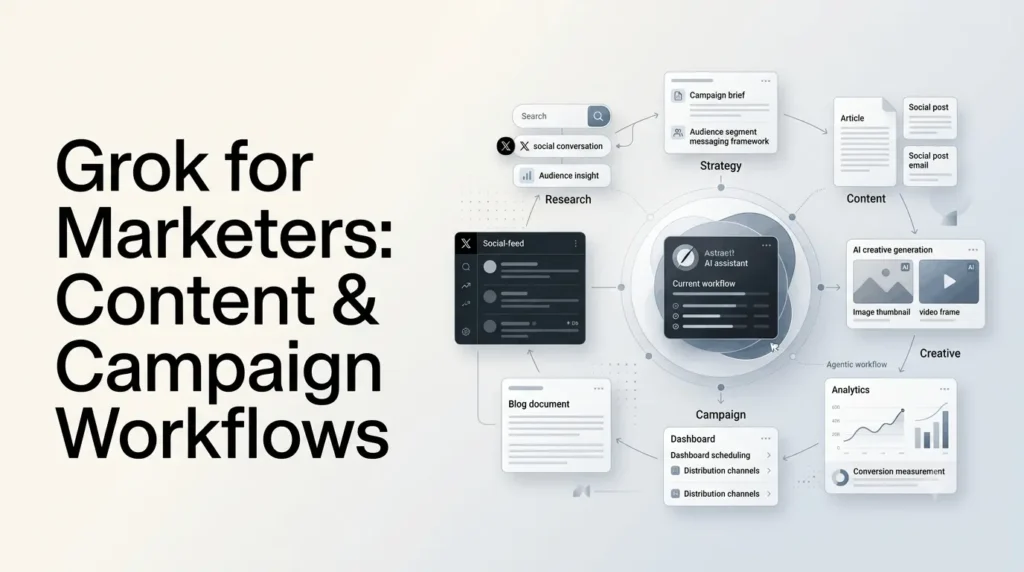
For marketers and creators, Grok for Marketers has evolved beyond a chatbot for answering questions. The current Grok AI ecosystem can support research, content ideation, social listening, campaign planning, image and video creation, data analysis, workflow automation, and agent-based execution.
The biggest shift is the move from asking Grok to generate individual pieces of content toward using Grok as part of a broader workflow. Grok 4.6 is designed for longer-running agentic work, while Grok Bot can operate a cloud computer and work across applications. Grok also has direct connections with X, giving marketers another way to research posts, trends, mentions, and conversations.
This makes Grok particularly useful for teams that need to move from research → strategy → content → creative production → campaign execution → analysis without treating each step as a completely separate task.
Quick Summary –
- Grok helps marketers with research, content creation, campaign planning, creative production, and analysis.
- It can analyze X conversations and trends to identify audience interests and content opportunities.
- Creators can use Grok to repurpose content into articles, social posts, emails, scripts, and visuals.
- Grok Imagine supports AI-generated images and video for marketing creatives.
- Grok Bot can automate repetitive, multi-step marketing workflows using connected tools.
- The best approach is to use Grok for research and execution while keeping humans in control of strategy and approval.
- Grok is particularly useful for creators, social media managers, SEO professionals, startups, and lean marketing teams.
What is Grok for Marketers?
Grok for marketers refers to using Grok’s AI capabilities to support marketing research, content production, social media workflows, campaign planning, audience analysis, creative development, and repetitive marketing tasks.
Grok can help with tasks such as:
- Finding current conversations and trends on X
- Researching a market or audience
- Developing content ideas
- Creating social media posts
- Repurposing long-form content
- Drafting campaign concepts
- Building content calendars
- Analyzing marketing data
- Generating images and video concepts
- Creating presentations and marketing documents
- Automating recurring workflows
- Delegating multi-step tasks to Grok Bot
The important distinction is that Grok does not replace a complete marketing strategy. Instead, it can reduce the amount of manual research, drafting, analysis, and execution required to turn an idea into a campaign.
Why Are Marketers Using Grok?
One of Grok’s strongest advantages for marketers is its connection to the X ecosystem.
Grok can access public X posts and conduct real-time web searches when appropriate. X also provides search, trends, and advanced search functionality that marketers can use for audience and conversation research.
This can make Grok useful when a campaign depends on understanding what people are discussing right now, rather than relying exclusively on older market research.
For example, a marketer launching a campaign around an AI product could use a workflow like:
Current conversations → audience pain points → content angles → campaign concepts → creative assets → distribution → performance analysis
Grok can assist with many of these steps.
How Can Marketers Use Grok for Content Research?
Before creating content, marketers need to understand what their audience cares about.
Grok can help turn broad subjects into research questions, audience pain points, content angles, and competitive themes.
1. Find current conversations
A marketer can ask Grok to investigate discussions around a product category, feature, industry problem, or emerging trend.
For example:
Analyze recent conversations about AI marketing tools on X. Identify recurring questions, complaints, misconceptions, and content opportunities.
Grok can use X posts and web search to provide a starting point for the research. However, important claims should still be checked against the original sources.
X’s search system also supports filtering by keywords, accounts, dates, locations, hashtags, and other criteria, making more targeted research possible.
2. Identify audience pain points
Instead of asking only for “content ideas,” marketers can ask Grok to categorize conversations into:
- Problems
- Questions
- Objections
- Desired outcomes
- Product complaints
- Feature requests
- Common misconceptions
This produces a more useful content strategy because ideas are connected to actual audience needs.
3. Turn research into a content brief
Once research is collected, Grok can convert it into a structured brief containing:
- Target audience
- Search or campaign objective
- Main topic
- Supporting topics
- Content angle
- Key questions
- Suggested headline
- Distribution channels
- Call to action
The marketer can then review and improve the brief before production.
How Can Creators Use Grok for Content Creation?
Grok can also function as a content-production assistant for creators.
Instead of generating one generic post, creators can use it throughout the content lifecycle.
Long-form content
Grok can help develop:
- Article outlines
- YouTube scripts
- Newsletter drafts
- Podcast outlines
- Research summaries
- Interview questions
- Video hooks
- Social content derived from longer material
A better workflow is to provide the source material first and ask Grok to transform it for specific audiences.
For example:
Blog article → YouTube script → LinkedIn post → X posts → Short-video hooks → Newsletter
This reduces the need to start from scratch for every platform.
Social media content
Grok can generate multiple versions of the same idea while changing:
- Tone
- Length
- Audience
- Platform
- Hook
- Call to action
- Educational depth
Creators should still edit the output so the final content retains their own voice.
X itself recommends keeping hashtags relevant and says no more than two hashtags per post is a best practice.
Grok for Social Media Marketing
One of the more interesting developments for marketers is Grok Bot’s integration with X.
xAI added an X connector to Grok Bot. A connected Bot can search posts, read a timeline, check mentions, and gather information about what is happening on X. xAI also added an X plugin capable of searching posts, reading timelines, pulling trends, and managing bookmarks.
This opens up more practical social-media workflows.
Example: X monitoring workflow
A marketer could structure a process like:
- Monitor a group of keywords.
- Identify relevant conversations.
- Group posts by topic.
- Detect recurring customer questions.
- Summarize emerging themes.
- Prepare potential content responses.
- Flag important conversations for human review.
The key advantage is that the marketer does not have to manually inspect every conversation.
Grok should still be treated as an assistant rather than an unquestioned publishing system. X explicitly applies quality and relevance controls to search, and its rules prohibit abusive automated posting and repeated near-duplicate content.
Using Grok for Campaign Planning
Grok can also help marketers move from an idea to a campaign structure.
A useful campaign-planning prompt might provide:
- Product
- Target audience
- Market
- Campaign objective
- Budget range
- Offer
- Brand voice
- Distribution channels
- Campaign duration
Grok can then help develop:
| Campaign Element | How Grok Can Help |
|---|---|
| Audience | Define segments and pain points |
| Positioning | Develop messaging angles |
| Content | Generate concepts and drafts |
| Social | Create platform-specific variations |
| Creative | Develop image/video concepts |
| Landing page | Structure copy and messaging |
| Draft sequences and variations | |
| Reporting | Summarize campaign data |
| Optimization | Identify possible improvement areas |
The marketer remains responsible for validating claims, positioning, targeting, compliance, and final messaging.
Grok for Marketing Images and Video
Grok is increasingly useful beyond text.
xAI’s current creative ecosystem includes Grok Imagine, which supports image generation and editing, while Imagine Video 1.5 provides image-to-video generation with improvements in motion, physics, audio, and speech.
For creators, this creates a workflow such as:
Campaign idea → creative brief → image concept → generated visual → video variation → social asset
Grok Imagine can be particularly useful for developing early creative concepts before a production team creates final assets.
For example, a brand could develop several visual directions for a product launch, compare them internally, and then select one direction for professional production.
Where AI-generated creative works best?
Grok-generated visuals can be useful for:
- Social media concepts
- Creative testing
- Mood boards
- Campaign prototypes
- Thumbnail concepts
- Product storytelling
- Short-form video ideas
- Early-stage advertising concepts
For regulated industries, product claims, branded assets, legal language, and sensitive imagery should receive human review.
Grok 4.6 and Marketing Workflows
Grok 4.6 is particularly relevant to advanced marketing workflows because xAI describes it as being designed for long-running agents and more ambitious interactive and visual work.
The model can sustain multi-step tasks involving research, analysis, coding, and creating work artifacts. xAI also says Grok 4.6 can research unfamiliar areas, structure projects, implement interactions, and continue refining them through multiple rounds of feedback.
For marketers, that matters because real campaigns rarely consist of a single prompt.
A campaign workflow might require:
Research → analysis → planning → drafting → revision → creative production → reporting
A model capable of maintaining context across longer tasks can potentially reduce the amount of manual coordination between those stages.
Grok 4.6 is also available through several developer platforms, including its API, Amazon Bedrock, Microsoft Foundry, and Gemini Enterprise Agent Platform. xAI lists API pricing starting at $2 per million input tokens and $6 per million output tokens for Grok 4.6.
That is more relevant to businesses building custom marketing applications than to a creator simply using Grok through its consumer interface.
Grok Bot for Marketing Automation
Grok Bot takes the concept further by allowing marketers to delegate work to an AI agent.
xAI introduced Grok Bot in August 2026 as a system of AI teammates with their own cloud computers. Bots can work across tools and applications, continue working in the background, and return when a task is completed or requires a decision.
Grok Bot was included with SuperGrok, SuperGrok Plus, SuperGrok Heavy, and selected Cursor plans. Its usage is separate from the normal Grok and Cursor usage included with those plans.
Marketing tasks that could benefit from Grok Bot
Potential workflows include:
- Competitive research
- Social listening
- Lead research
- Campaign research
- Content research
- Website monitoring
- Marketing reporting
- Inbox organization
- Data collection
- Repetitive administrative work
For example, instead of asking:
“Give me five marketing ideas.”
A marketer could delegate a more complete job:
Research the latest discussions about [product category], identify recurring customer problems, organize the findings by theme, prepare five campaign angles, and create a short brief for each. Flag any claims that require source verification.
The second approach gives the AI a job to complete, rather than simply requesting a piece of text.
A Practical Grok Marketing Workflow
A useful end-to-end workflow can be divided into six stages.
Step 1: Research
Use Grok to investigate:
- Industry developments
- Customer questions
- Competitors
- X conversations
- Search topics
- Product reviews
- News
- Audience pain points
Always identify the original source for important facts.
Step 2: Strategy
Turn the research into:
- Audience segments
- Campaign objectives
- Messaging pillars
- Content themes
- Distribution channels
- Calls to action
Step 3: Content Production
Create:
- Articles
- Social posts
- Email drafts
- Video scripts
- Ad concepts
- Landing-page copy
Give Grok clear brand guidelines and source material rather than asking for generic copy.
Step 4: Creative Production
Use Grok’s image and video capabilities to develop:
- Visual concepts
- Campaign images
- Video concepts
- Storyboards
- Thumbnail ideas
- Creative variations
Step 5: Distribution
Adapt the campaign for each platform rather than publishing identical content everywhere.
For example:
One campaign → X thread → LinkedIn post → Instagram concept → YouTube script → Email → Blog article
Step 6: Analysis
Feed campaign results back into the workflow.
Grok can help summarize:
- Click-through rates
- Engagement
- Conversion data
- Content performance
- Audience feedback
- Campaign differences
The goal is not simply to generate more content. It is to create a feedback loop where performance influences the next campaign.
Grok vs Traditional AI Content Workflows
The major difference is the shift from generation to orchestration.
| Traditional AI Workflow | Grok-Based Workflow |
|---|---|
| Ask for one article | Research → outline → draft → refine |
| Manually research X | Use X data and search capabilities |
| Create visuals separately | Combine text, image and video workflows |
| Manually repeat tasks | Use automation or agents where appropriate |
| One prompt at a time | Longer multi-step workflows |
| Human moves information between tools | Agents can work across connected tools |
| Generate content | Research, execute, analyze and iterate |
This does not mean every task should be automated. Marketing often involves brand judgment, creative taste, legal review, and business decisions that require human involvement.
What Are the Limitations of Grok for Marketers?
Grok can accelerate marketing work, but it should not be treated as an autonomous source of truth.
1. AI-generated information can be wrong
X’s own documentation warns that Grok can provide incorrect information or miss context. Its ability to access real-time information does not eliminate the need for verification.
2. Brand voice still needs human control
A technically correct piece of copy can still sound wrong for a brand.
Marketers should provide:
- Brand guidelines
- Examples of approved copy
- Words to avoid
- Target audience
- Tone
- Product positioning
- Legal requirements
3. Automation can create mistakes at scale
An incorrect manual post affects one piece of content. An incorrect automated workflow can potentially repeat the same mistake many times.
This is why approvals are important for consequential actions.
4. Platform rules still apply
AI-generated content does not bypass X’s rules around spam, automation, duplicate content, or search manipulation.
5. Not every task benefits from agents
A simple social post may be faster to write manually with AI assistance than to create an elaborate automated workflow.
Agents make more sense when a task is:
- Repetitive
- Multi-step
- Time-consuming
- Clearly defined
- Based on accessible data
- Easy to verify
How Should Marketers Prompt Grok?
The quality of the workflow depends heavily on the quality of the instructions.
Instead of:
Write a campaign for my product.
Try:
You are a B2B SaaS marketing strategist. Create a campaign for [product] targeting [audience]. The objective is [objective]. Use the supplied product information as the factual source. Develop three positioning angles, explain the reasoning behind each, then create a content plan for X, LinkedIn, email, and a landing page. Clearly identify any assumptions that require validation.
A strong marketing prompt usually defines:
Role + context + objective + audience + source material + constraints + output format + approval requirements
This gives Grok a much clearer operating framework.
Who Should Use Grok for Marketing?
Grok can be useful for:
- Social media managers
- Content marketers
- SEO professionals
- Digital marketers
- Startup founders
- Influencers
- YouTubers
- Newsletter creators
- Advertising teams
- Growth teams
- Small businesses
- Marketing agencies
It is especially useful for individuals or small teams that need to handle research, content, creative development, and analysis without maintaining a large specialist team for every function.
Is Grok Good for Content Creators?
Yes, particularly when a creator needs to produce content across multiple formats.
A creator could use Grok to move from:
Idea → research → script → visual → short-form content → social posts → performance analysis
The biggest benefit is not simply writing faster. It is reducing the friction between different stages of production.
Creators should still maintain their own editorial voice, opinions, creative direction, and fact-checking process.
Is Grok Free for Marketers?
Access depends on the specific Grok product and plan.
Grok has been available across X and dedicated Grok experiences, while more advanced capabilities and usage limits can vary by subscription and platform. Grok Bot, for example, is currently included with selected SuperGrok and Cursor plans rather than being universally available on every plan.
Grok Build has also expanded from an earlier limited beta to availability on every plan on web and mobile, allowing users to describe an app, game, website, or dashboard and have Grok build a working version.
Because access and limits can change, marketers should check the current plan and feature availability before designing a workflow around a specific capability.
Best Practices for Using Grok in Marketing
For reliable results:
- Give Grok source material instead of relying on general knowledge.
- Ask for sources when researching factual claims.
- Separate research from publishing.
- Use a consistent brand voice guide.
- Keep humans in the approval loop for important campaigns.
- Test multiple creative angles rather than accepting the first output.
- Avoid automatically publishing unreviewed AI content.
- Measure actual campaign performance.
- Use automation for repetitive tasks, not strategic decisions.
- Review platform policies before automating social activity.
Future of Grok for Marketers and Creators
The direction of Grok suggests that marketing use is moving toward agentic workflows rather than isolated AI generation.
Grok 4.6 is designed around longer-running agentic tasks, Grok Bot can perform work using a cloud computer, and Grok’s X integration allows agents to interact with posts, timelines, mentions, trends, and bookmarks. xAI has also expanded Grok across productivity tools such as Word, PowerPoint, Excel, Outlook, and Google Workspace.
That could eventually make the marketing workflow look less like:
Human → AI prompt → AI response
and more like:
Goal → Research → Strategy → Creation → Execution → Measurement → Optimization
The important change is that AI becomes part of the workflow itself rather than simply a writing assistant.
Conclusion
Grok has become more relevant to marketers and creators because its capabilities now extend well beyond basic AI writing.
It can support the complete marketing cycle: research, strategy, content creation, creative development, social listening, automation, and analysis.
The most useful approach is not to hand over an entire marketing strategy to AI. Instead, use Grok to handle research-heavy and repetitive work while keeping humans responsible for positioning, creativity, fact-checking, brand decisions, and final approvals.
For creators and lean marketing teams, that combination can turn Grok from a content generator into a practical workflow assistant, and, increasingly, an AI agent capable of completing parts of the workflow itself.
Frequently Asked Questions (FAQs)
1. What is Grok for marketers?
Grok for marketers is the use of Grok’s research, reasoning, content, creative, automation, and agent capabilities to support marketing activities such as audience research, content creation, social listening, campaign planning, and analysis.
2. Can Grok create marketing content?
Yes. Grok can help create social posts, articles, scripts, campaign concepts, email drafts, content briefs, and other marketing materials. Human editing is still important for brand voice, factual accuracy, and final approval.
3. Can Grok help with social media marketing?
Yes. Grok can analyze public X conversations and, through Grok Bot’s X integration, search posts, read timelines, check mentions, gather trends, and manage bookmarks.
4. Can Grok create marketing images and videos?
Yes. Grok Imagine supports image generation and editing, while Imagine Video 1.5 supports image-to-video generation and includes improvements in motion, physics, audio, and speech.
5. Can Grok automate marketing tasks?
Some marketing tasks can be automated through Grok’s automation and agent capabilities. Grok Bot can perform multi-step work using its own cloud computer and connected applications. The most appropriate tasks are repetitive, clearly defined, and easy to verify.
6. Is Grok better for marketers than a traditional chatbot?
Its advantage is not simply text generation. Grok’s current ecosystem combines real-time information access, X integration, creative generation, productivity integrations, automation, and agentic capabilities. The best choice still depends on the marketer’s specific workflow and tools.
Also Read –
Grok Pricing: Plans & Costs Explained
Grok AI Models: Ultimate Comparison Every Model Explained
Grok Bot Guide: Everything You Need to Know in 2026
Build Anything with Grok: A Complete Grok Build Guide
Grok 4.6 AI Guide: Everything About Its Features, Pricing, Benchmarks and Availability