
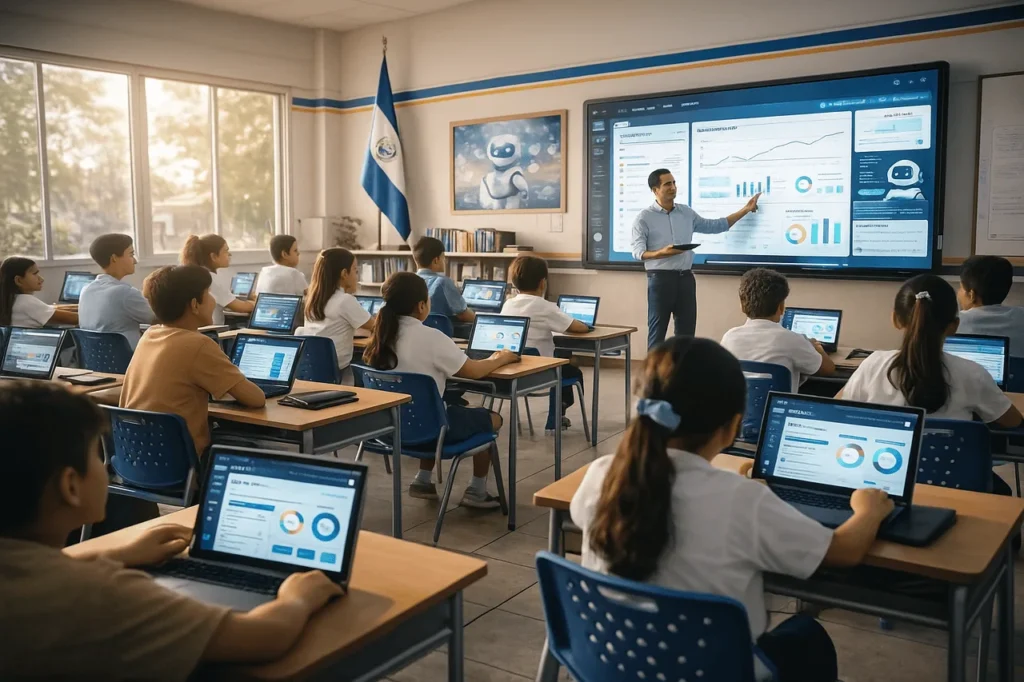
El Salvador has taken a bold step to change how public schools are viewed in education. The country has joined forces with Musk’s AI company, xAI, to deploy an AI-powered tutoring system nationwide. The program was announced in December 2025. The two-year plan will integrate an xAI Grok model into more than 55,000 public schools and reach more than 1 million students across the United States, from rural to urban areas. This project aims to customise education and provide teachers with cutting-edge technology, and could become a global model of AI-enhanced education.
In this article, you will learn about the El Salvador AI education initiative and how it aims to transform public schooling through personalized AI learning.
A Landmark AI Education Initiative in El Salvador
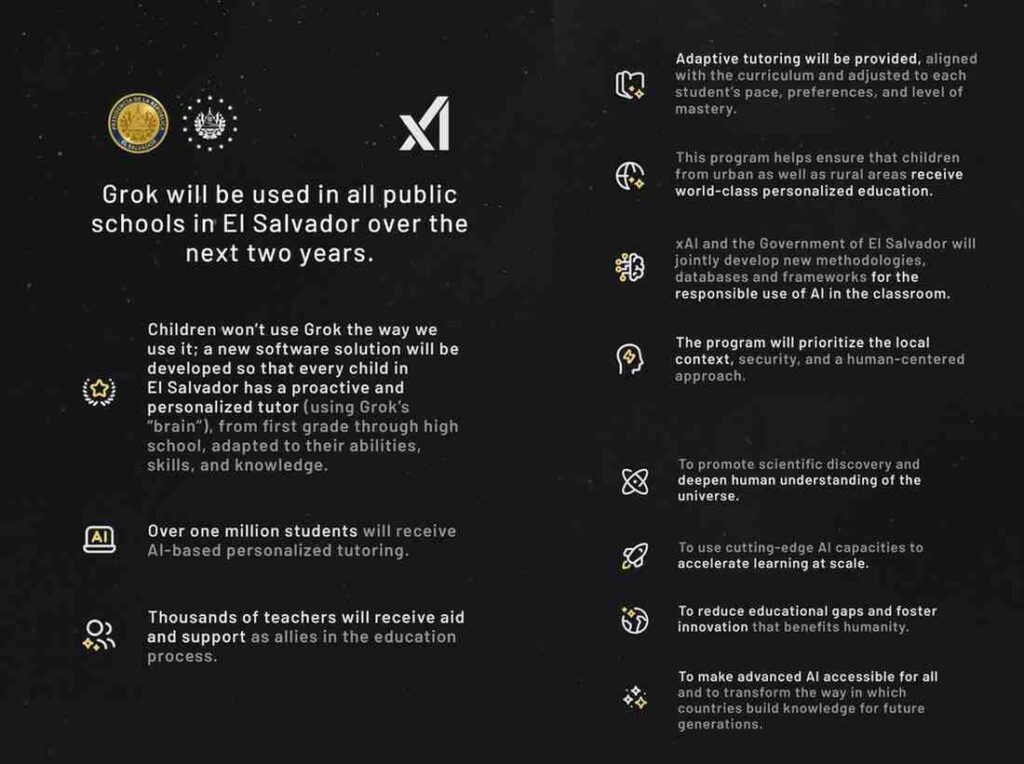
As part of the agreement between the Government of El Salvador and xAI, Grok, an AI-powered conversational system developed by xAI, will be integrated into the national education system as an adaptive tutoring tool. Within the next two years, all public schools nationwide will be able to use AI-driven learning assistance tailored to each pupil’s educational content, needs, preferences, and academic goals.
According to official announcements, this launch will offer courses aligned with the curriculum and provide real-time feedback, as well as personalised instruction, in crucial disciplines like math, science, and language arts. The scope of implementation is the largest, all-encompassing AI education program of this type, putting the most modern AI directly in the hands of an entire generation.
What is the best way to use Grok in the Classroom?
Grok’s integration was created to improve existing teaching methods, not to replace teachers. Students can engage with Grok’s AI to get instant answers and exercises that help clarify complex topics. The system will analyse each student’s performance and tailor lessons to their strengths and weaknesses.
Teachers will, in turn, be supported by software that automates the process of helping handle administrative and instructional tasks, like:
- Learning: planning and creating resources. Develop lesson materials that are tailored to the learning goals.
- Feedback, as well as Grading, offer quick evaluations of assignments and helpful information.
- Tools to support the classroom that help monitor student performance and customise instruction to groups.
This method is designed to reduce teachers’ burden and allow them to focus on students’ participation and on more challenging task-based teaching.
El Salvador AI education initiative: Teachers’ Empowerment by Using AI Tools
Grok initiative also includes AI-powered tools. Grok initiative also offers AI-powered tools designed to aid educators in their tasks. These tools are designed to:
- Streamline the lesson-making, along with ideas for curriculum and content generation
- Automate the Process of Grading and Assessment, as well as reducing the administrative burden
- Support for classrooms, such as the creation of quizzes or explaining documents
By automating repetitive tasks, teachers will be able to spend more time on student engagement, differentiated teaching, and innovative classroom strategies. According to the official materials for the program, xAI and El Salvador collaborate on the development of the systems to ensure that they are in line with the country’s national curriculum and standards for education.
El Salvador AI education initiative: Potential Opportunities and Rewards
The size and scope of this initiative provide several significant opportunities:
1. Equal Access to High-Quality Education
Through the integration of AI across more than 500 educational institutions, El Salvador aims to reduce socioeconomic and geographic gaps in access to education and its quality. AI tutoring is particularly effective in rural areas with the most limited resources for teaching.
2. Increased Student Engagement
Adaptive systems keep students engaged by adjusting their pacing and difficulty, thereby increasing student retention and overall performance.
3. Help for Teachers
AI can help educators complete their tasks efficiently, allowing them to focus on engaging and innovative teaching methods.
4. Leadership in Innovation
El Salvador’s model could serve as an example of how emerging economies can harness technology to overcome traditional constraints to development.
El Salvador AI education initiative: The Building of AI Literacy and Responsible Use
Beyond the class, the project is designed to expand the teachers’ and students’ understanding of AI. By utilising intelligent systems from the beginning, students can become familiar with the latest technology, which is increasingly essential for jobs in the near future.
The XAI and the Ministry of Education in El Salvador plan to work together in the development of new frameworks for teaching, data sets and safety standards created to facilitate teaching AI use. These guidelines will help ensure an ethical and safe use of data, protect students’ personal data and ensure that AI outputs are geared towards education.
El Salvador AI education initiative: Strategic Vision and National Goals
President Nayib Bukele of El Salvador has described his partnership with the country as a revolutionary step for the country’s education system. A pioneer in the field of disruptive technology, including making bitcoin legal for use in 2021 and launching digital health initiatives, President Bukele considers AI a way to accelerate development in the country and reduce the gap between the rich and the poor. In public announcements, Bukele has emphasised that El Salvador is not waiting for the future to arrive and is actively creating it. This perspective positions the country as a potential global leader in public service delivery that integrates AI. Elon Musk echoed this sentiment, saying the project will put the most sophisticated AI technology directly in the hands of a complete generation, reflecting the ambition and faith in the technology’s future potential to improve education.
xAI has also announced plans to work with other organisations to develop innovative methods, datasets, and ethical and legal frameworks to ensure responsible AI use in schools and, possibly, as an alternative for other nations looking at similar applications.
El Salvador AI education initiative: Challenges and aspects
Despite its promise, the project has provoked debate and raised some important questions.
Data Security and Privacy
With the increasing popularity of AI integration, questions about the protection and management of student data are of paramount importance. Making sure that educational and personal data is secure and handled responsibly will be essential.
AI Integrity and Bias
Grok’s previous performance has sparked controversy and allegations of bias or inadvertent outputs. Although xAI has taken steps to improve the quality of its models, critics claim that deploying large-scale language models in education requires robust protections and oversight.
Infrastructure Limitations
Effective AI deployment relies on stable internet connections and digital infrastructure, which rural communities often lack. The solution to these issues is crucial to achieving equity in AI.
Educator Training
Teachers need to be taught to use AI tools ethically and effectively to achieve positive results. If they do not receive adequate professional development, the full benefits of AI assistance cannot be fully realised.
Global Implications: A New Model for Education?
El Salvador’s experiment could have a wide-ranging impact on how countries adopt AI for public services. As governments around the world face increasing demands on education and resource constraints, massive-scale AI adoption could offer an opportunity to enhance educational quality and reduce the burden on schools.
If the project succeeds, the results could inform discussions on AI ethics, technology and the classroom, and the concept of digital equity. Countries facing similar development challenges might consider El Salvador’s model for leveraging the latest technologies to support students effectively.
What AI could redefine the field of education within El Salvador?
Salvador’s AI education program is a historic test in the intersection between technology, policy, and national progress. The results will inform worldwide discussions on the importance of AI in public service, especially in education. As the implementation process unfolds over the next two years, teachers, policymakers, and technologists will closely monitor its impact on learning outcomes, classroom dynamics, and students’ socioeconomic equality.
Final Thoughts
The partnership between El Salvador and xAI is not just an investment in technology. It’s additionally an investment in the human capital and long-term growth for the nation. By integrating the latest AI tools into classrooms and schools, it seeks to personalise education, giving teachers more autonomy and ensuring that a student’s geographical or socioeconomic status doesn’t limit their access to top-quality education. But the program is focused on the responsibilities that come with technological advancement. Data security and a solid unifying governance system will be essential in the overall success of this program. If it’s done right, the widely used Grok implementation could become a globally recognised reference point for demonstrating how AI could aid human growth in education. This will indicate that what’s coming in the near future in education isn’t just computerised, but has been carefully planned for students and teachers alike.
Frequently Asked Questions
1. How exactly does El Salvador’s xAI Education initiative work?
It’s a collaboration between the El Salvadorian Government of El Salvador and xAI to roll out Grok AI tutoring tools in over 5,000 public schools. It will allow for the customisation of the learning experience of over one million students over two years.
2. What do I make Grok aid students and teachers?
Grok provides an adaptable, curriculum-aligned tutoring service for teachers and students, along with tools for lesson planning, grading, and classroom management.
3. Will teachers be replaced by AI?
No. It isn’t. AI was designed to improve teachers’ work by helping with repetitive tasks and providing instruction, but it is not intended to substitute for teachers.
4. What could be the potential problems that might arise from AI? AI rollout?
Issues include maintaining a stable system to protect student information, addressing AI biases, and ensuring a moral approach to technology use throughout the course.
5. What is the reason this initiative is so significant in the world?
It’s believed to be the nation’s first AI education program and could influence how other countries implement AI in their public education systems.
6. What do you imagine the date will be for the deployment?
It is scheduled to roll out fully over 2 years, beginning on the official announcement date in December 2025.
Also Read –
How xAI Is Competing in the AI Race | Strategy, Grok AI & Market Position