
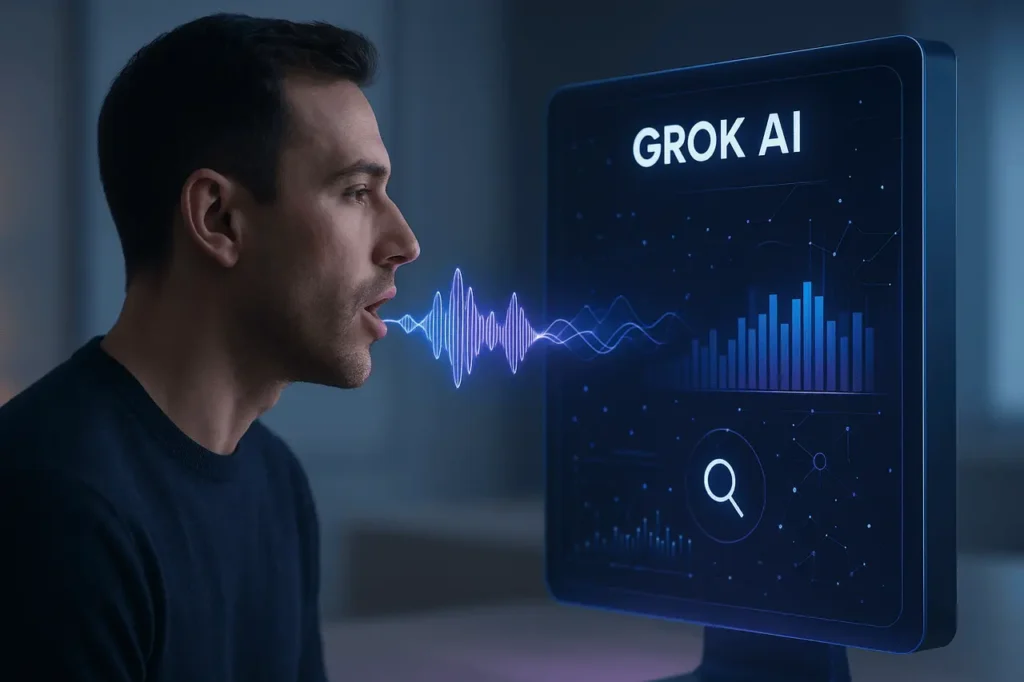
Grok AI, developed by Elon Musk’s artificial Intelligence company xAI, is a thriving category of intelligent AI assistants that blend conversational fluency and real-time access to information. In 2025, Grok is expanding beyond text-based chat and has added a new voice mode that is an interactive experience designed to make conversations through AI easier to understand and flexible. This article explores Grok AI’s voice mode, how Grok’s voice capabilities work, what makes them unique, and how people can use the features effectively.
What is Grok AI?
Grok is an intelligent AI chatbot based on large-language model technology and developed by xAI. It first came out in late 2023 and has been refined through various versions (including Grok 4 and 4.1) that enhance reasoning and emotional intelligence and integrate with real-time social and web media data. In contrast to other generative models that rely solely on static training data, Grok’s design enables real-time search, allowing it to retrieve and frame responses with up-to-date information from the web and social platforms such as X (formerly Twitter).
Understanding Grok Voice Mode
Grok’s voice mode lets users communicate with the AI by speaking rather than typing. The result is conversations that are more fluid and conversational, in which the system listens to voice input and responds with an audible response.
Grok AI voice mode: The Key Characteristics of Voice Interaction
- Speech Recognition: People can speak naturally into microphones, and Grok converts speech to text for processing.
- Natural-Voice Output: Grok speaks out the responses with an integrated text-to-speech interface. Third-party extensions and experimental features can improve the experience with additional voice-specific modifications.
- The Continuous Dialogue flow: conversations don’t have to be limited to a single conversation; Grok can maintain context across multiple queries in a series, enabling a more human back-and-forth.
- Pause and Resume Controls: The user can pause, resume, or stop the microphone at any time, providing flexibility without reopening the interface.
Voice is accessible across Grok platforms, including the web app, iOS and Android versions, and (in enhanced or experimental forms) through integrations such as specific web browser extensions.
The Story Behind the Tech: What is it? Grok Voice Works
At its core, Grok’s voice mode combines text-to-speech (STT) and text-to-speech (TTS) engines with a large language model. When someone speaks to the system, it:
- Captures audio signals through an audio microphone.
- Transcribes speech into texts to allow an analysis of the semantics.
- Processes the content to generate appropriate responses.
- Outputs spoken replies in natural-sounding audio.
This pipeline enables fluid conversations and integrates with real-time search functions to ensure that answers don’t have to be tied to existing knowledge but can reflect current developments in the data or events.
The latest version of Grok (e.g., Grok 4.1) enhances creativity and emotional understanding, making responses more nuanced and contextually sensitive.
Grok AI voice mode: Advantages of using Grok Vocal Mode
Additional Natural Conversations
Voice interaction mirrors human communication patterns, making AI seem less like a command-line application and more like a conversation partner. This could reduce the friction for those who prefer speaking over typing.
Hands-Free Accessibility
Voice mode is a great option when hands-free use is crucial, such as when you are multitasking or in situations that require mobility, like cooking or driving.
Real-Time Information
Because Grok integrates live data from the web and social networks, conversations can be based on current trends, events, and even news, providing an engaging and interactive experience.
Flexible Controls
A capability to pause, restart, or stop listening, without having to reopen the application, improves user experience and gives you more control over conversations.
Grok AI voice mode: Limitations and user Experience
Grok’s Voice Mode is a groundbreaking step in the right direction, but it’s not without its challenges:
- Natural Voice: Some users report that the voice quality may be more synthetic than an entirely natural conversation, depending on the software and device.
- Individuality Mods: The character’s audio output can vary widely based on personal preferences. Some options may appear fun or unorthodox, rather than professional.
- Privacy of Data: The voice input can be recorded or analyzed to improve response times, and the user should be aware of the privacy guidelines for audio data.
Grok AI voice mode: Application Cases Practical about Grok Voice
Everyday Q&As and Searches
Instead of writing, the user can ask questions out loud and receive immediate responses on a variety of topics, from news and weather to “how-to” guidelines.
Creative and Educational Assistance
Voice mode is an excellent tool for the creative process, allowing you to brainstorm ideas, write explanations, or discuss complex subjects conversationally.
Multitasking and Productivity
Both professionals and casual users benefit from hands-free communication while managing other workflows or tasks.
Integration with Smart Devices
Voice interactions are well-suited for integration into vehicles, mobile devices, and future IoT platforms, and could serve as an AI co-pilot in everyday activities.
Grok AI Voice Mode: Best Practices for Using Grok Voice Mode
- Talk Clearly: Enunciate questions and prompts to increase the accuracy of speech recognition.
- Utilize the Concept of Context Continuity. Make your inquiries in the logical order to ensure conversational coherence.
- Adjust the Voice Options: Where you can, play around with voice tone or personality to match the environment (professional as opposed to more casual).
- Stay Mindful of Data Use: Review your privacy settings if you regularly use voice input.
Final Thoughts
Grok’s voice mode is an essential step towards more real-time and immersive AI conversations. The ability to continuously listen, respond with an audible sound, and include live data is ideal for daily questions, hands-free usage, and conversations that benefit from live context. Although the quality of voice and personalization is still in development, the overall experience demonstrates how conversational AI is advancing towards human-like interaction. As Grok’s fundamental models and voice technology develop, the voice-driven AI will likely become a standard interface, changing the way that users look up information, study, and interact with electronic systems throughout their daily lives.
Frequently Answered Questions (FAQs)
1. What devices support Grok voice mode?
Grok’s voice feature is available on web browsers (with microphone connectivity), iOS and Android apps, and some extensions that support voice-based interactions.
2. Does Grok search on the internet in real-time?
Grok can indeed read and integrate real-time data from various public sources on the web, including social media networks, to inform its decisions.
3. Are my voice-related data being saved by Grok?
Voice inputs are processed and stored in accordance with Grok’s privacy guidelines, mainly when used to enhance response quality.
4. Is it possible to turn off Grok Voice Mode?
Yes, users can turn off microphone access or switch back to text entry at any moment.
5. Is the Grok voice like a human conversation?
The experience differs depending on the implementation and the voice engine, though it is generally efficient; some users notice differences compared to entirely natural human speech.