
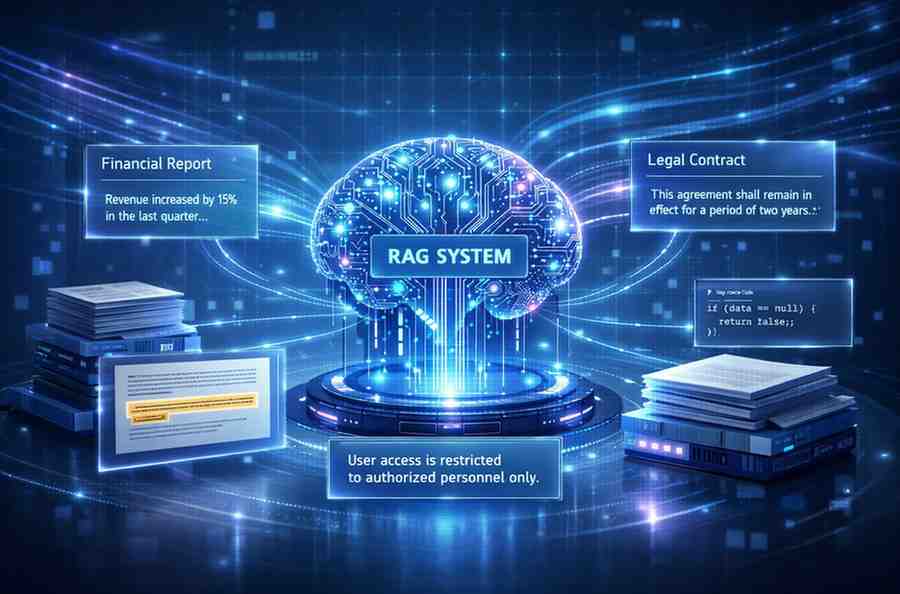
In the last week of December 2025, xAI announced its Grok Collections API, which is an innovative Retrieval-Augmented Generation (RAG) system that was designed to revolutionise the way companies and developers search to retrieve, analyse, and think about complex data at a massive scale. This release incorporates a highly performant retrieval layer right into the API infrastructure of xAI that promises substantial enhancements in reliability, accuracy, and its application to a range of real-world applications such as finance, legal, and engineering software.
Through the combination of powerful hybrid search methods with deep reasoning capabilities, the Grok Collections API aims to solve the common issues that arise from big language models, including hallucinations. It is also able to provide powerful, contextually aware insights from lengthy and dense documents. This article explains the way that the system functions with its primary functions, applications that can be used, and the reasons why it is essential for both developers and enterprises’ AI workflows.
What Is Retrieval-Augmented Generation (RAG)?
RAG stands for Retrieval-Augmented Generation (RAG), which can be described as an AI framework that augments traditional large-language models by incorporating an explicit step for information retrieval prior to generating responses. Instead of relying only on the pre-trained information, RAG models dynamically pull relevant context from outside data sources like knowledge bases, document collections, or databases, and utilize this information to guide and build outputs based on actual evidence.
This approach helps reduce hallucinations–situations where the model fabricates information unrelated to real sources–and improves the reliability of outputs, especially for domain-specific or rapidly evolving content. By establishing the basis of generation on real document retrieval, the RAG system delivers higher precision, contextually anchored, and reliable outputs than standard LLM responses.
Core Features of the Grok Collections API
1. Integrated RAG Capability
Grok Collections API Grok Collections API integrates the latest RAG directly in the xAI API framework, which enables seamless reasoning and retrieval workflows with no separate infrastructure. It allows indexing, uploading, and searching different types of data, which will enable developers to create intelligent applications that use the most current, accurate data.
2. Hybrid Search for Precision and Recall
The system provides different search modes:
- Semantic Search Learns the meaning and context of keywords.
- Keyword Search: Matches literal terms for precise queries.
- Hybrid search: Combining keywords and semantics to produce optimal results, and is particularly efficient when dealing with large datasets.
This method of layering allows Grok Collections to find the most pertinent passages, even in dense and long documents, like financial reports, contracts, and sources of code.
3. Support for Diverse File Formats
Grok Collections handles a broad array of document formats such as PDFs, spreadsheets, text files, and code repositories. They offer features such as optical character recognition (OCR) and layout-aware parsing, which preserve the structural integrity of documents during retrieval. This makes it ideal for data archives in the enterprise sector, which contain data in a variety of types.
4. High-Performance Document Reasoning
Beyond the simple retrieval of data, the simple retrieval API is designed to make sense of the returned data and extract tabular data, understand the numerical data, and respond to multiple-step analytical queries. Internal benchmarks reveal the performance of competitors or better in real-world situations in the legal, finance, and coding fields.
5. Scalability and Workflow Integration
The documented API model of xAI allows for seamless integration with existing tech stacks. Developers can control their collections in a programmatic manner, update their indexed files, and perform searches in applications. This is the basis for AI chatbots, dashboards for analytics, and automated knowledge platforms.
How Grok Collections Reduces Hallucinations?
One of the significant issues in the field of generative AI is hallucination, in which the model generates false but plausible information. The main benefit of RAG, particularly when paired with hybrid search, is the stronger proof base:
- The retrieval of precise phrases pertinent to queries improves the accuracy of facts.
- Layers of reasoning make sure that the responses are built from context retrieved instead of internal biases or patterns that have been memorized.
In making the model refer to real content in documents prior to answering, Grok Collections mitigates uncertainty and aligns outputs to verifiable sources.
Grok Collections API: Practical Applications Across Industries
Finance
Financial professionals handling financial reports on earnings, balance sheets, and regulatory filings gain from the precise retrieval of numerical and tabular data. Hybrid searches extract crucial financial data, allowing analysts to concentrate on insight generation instead of manual document sorting.
Legal and Compliance
In legal workflows where statutes and contracts frequently have several hundred pages, Grok Collections can pinpoint pertinent clauses, provide a summary of obligations, and assist in due diligence workflows with more assurance and lower manual effort.
Software and Coding
Massive codebases containing interdependent files can pose a challenge to retrieval in AI systems. Grok Collections can find definitions, identify relevant code blocks, and incorporate the tasks into reasoning. Helping developers in debugging and analysis.
Customer Support and Knowledge Management
Enterprises can develop AI agents that search internal documents to respond to employees’ or customers’ questions. By establishing answers in guidelines and official policies, companies can provide exact support solutions at scale.
Grok Collections API: Pricing and Access Overview
Early reports indicate that xAI provides introductory pricing tiers that include free file indexing and storage for the initial period and charges based on the quantity of retrieval operations that exceed the thresholds. Pricing strategies are intended to assist developers in integrating advanced RAG capabilities with minimal upfront costs of infrastructure.
Grok Collections API: Implementation Considerations
SDK and Tooling
Grok Collections is compatible with existing SDKs, using specific tools for tasks such as:
- The uploading process and the management of the collection
- Implementing hybrid and semantic search
- Integration of retrieval in AI workflows. AI workflows
It is possible to assist developers in utilizing the API across languages and in different environments.
Data Governance and Security
For enterprise deployment, data governance remains crucial. Documents that are sensitive should be secured with the appropriate access control and encryption, especially when they are integrated with retrieval systems that are external to the enterprise.
My Final Thoughts
The Grok Collections API is a significant step ahead in the field of RAG implementation. By bringing together sophisticated retrieval technology, hybrid search, and deep reasoning in an API that can scale the xAI solution, companies and developers can create AI systems that are more precise and reliable, as well as sensitive to context, than conventional models on their own.
In everything from legal analysis, financial research, to exploring code, Grok Collections is poised to improve workflows when document retrieval is a key element. Its primary focus on reducing hallucinations and providing specific evidence makes it an attractive option for future-generation AI applications.
Frequently Asked Questions
1. What is the Grok Collections API?
This is an API of xAI, which combines retrieval-augmented generation, advanced search capabilities, and reasoning for uploaded datasets and documents.
2. What is the best way to help Grok Collections improve accuracy?
It extracts specific phrases from data sources and applies this context to inform AI outputs, which reduces hallucinations.
3. What types of files will it be able to manage?
The API can work with various formats for data that include PDFs, CSVs, and spreadsheets. It also supports text files, as well as code repositories.
4. Where can it be most beneficial?
It’s particularly valuable in the fields of legal, finance, and coding, customer service, as well as the management of knowledge in areas where the information is dense and needs to be easily accessed.
5. Does it allow semantic and keyword searches?
Indeed, the developers are able to select semantic, keyword, and hybrid strategies to ensure the best results.
6. How can I start using Grok Collections?
Utilize the API documentation and SDKs of xAI to upload your document collections to index them, then incorporate search capabilities within applications.
Also Read –
Grok Voice Agent API: Build Real-Time Multilingual Voice Agents
The Context Memory War: How xAI Is Rewriting the Future of AI with Long-Context Models