
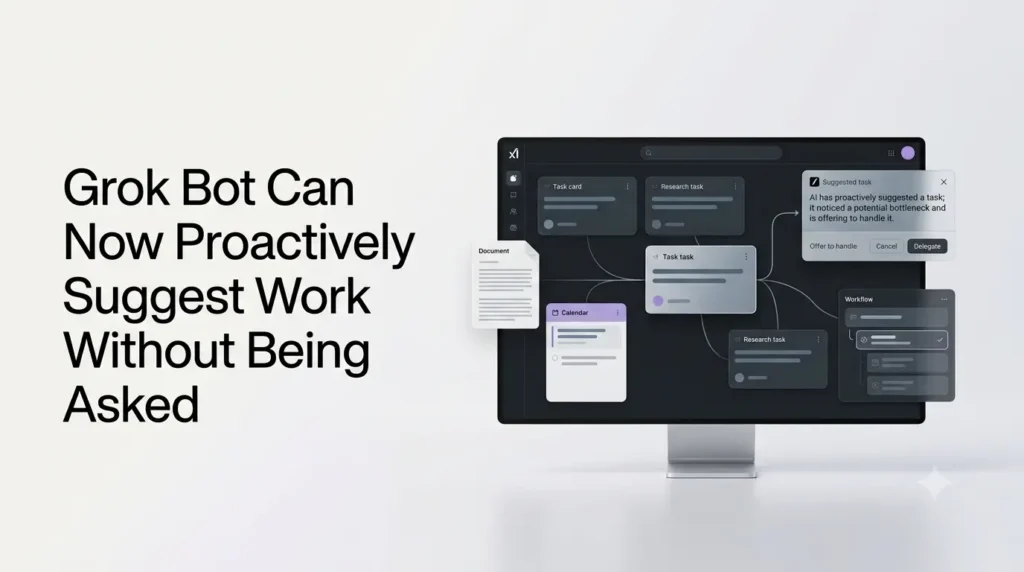
Grok Bot is gaining a new proactive capability that allows its Primary Bot to identify work it can handle and offer to take it on before the user asks. The feature is rolling out to users and, according to the announcement, the suggestions themselves do not count against Grok Bot usage.
The update changes how users interact with Grok Bot. Instead of requiring people to continually identify tasks and delegate them, the Primary Bot can now surface potential work on its own.
The feature builds on Grok Bot’s existing design as a persistent AI agent that can work across applications, maintain context and execute multi-step tasks on a user’s behalf.
Quick Summary
- xAI is expanding Grok Bot with a more proactive interaction model.
- The Primary Bot can identify work it may be able to handle and suggest taking it over.
- The feature reduces the need for users to initiate every task manually.
- xAI says the suggestions themselves don’t count against usage.
- Grok Bot is designed around persistent AI agents with their own cloud computer, tools, memory and workflows.
- The development reflects the broader shift from conversational AI toward agentic AI and autonomous task execution.
- xAI’s own design documentation specifically describes Grok Bot as supporting work that can begin without a prompt.
What the New Grok Bot Feature Does?
The central change is proactive task suggestions.
Previously, users generally had to give a Bot a task, create a routine or establish a workflow before the agent could begin working. Grok Bot’s newer approach allows the Primary Bot to recognize opportunities where it may be able to help and present the user with an offer.
In practical terms, the experience is closer to having an AI assistant that can identify potential work rather than simply waiting for instructions.
The announcement describes the Primary Bot as being able to spot work it can take off the user’s plate and offer to handle it.
That makes the Primary Bot an important layer between the user and the other specialized Bots that can perform individual tasks.
How Grok Bot’s Primary Bot Fits Into the System?
Grok Bot was introduced as a platform for persistent AI teammates rather than a conventional chatbot.
Its Bots can operate their own cloud computer, sign into applications and websites, and work through tasks while the user is away. xAI says Bots can also work in parallel and coordinate with other Bots.
The product supports several concepts:
- Bots: Persistent AI agents assigned specific responsibilities.
- Primary Bot: The user’s main Bot that can coordinate work and interactions.
- Routines: Repeatable workflows that a Bot can execute independently.
- Tools and connectors: Integrations that allow Bots to access applications and information.
- Computer use: The ability to operate websites and software through a cloud computer.
The new proactive suggestions feature adds another layer to this system by allowing the primary agent to initiate potential work instead of waiting entirely for a user request.
Grok Bot Proactive Suggestions and Usage
One of the most notable parts of the announcement concerns usage.
xAI says that suggestions do not count against usage. This matters because proactive agents could otherwise create concerns about an AI system consuming usage simply by monitoring situations and generating recommendations.
The announcement specifically refers to the suggestions themselves.
It does not, however, publicly explain in detail whether accepting a suggestion and allowing the Bot to execute the resulting task is treated differently from the suggestion itself.
For that reason, users should distinguish between:
| Activity | Information currently available |
|---|---|
| Primary Bot suggests a task | xAI says the suggestion does not count against usage |
| User accepts the suggestion | Detailed usage treatment is not specified in the announcement |
| Bot executes the task | Execution uses the Bot’s normal capabilities and available usage |
| Recurring work | Grok Bot already supports routines and persistent workflows |
This distinction is important when discussing the feature because “suggestions are free” does not necessarily mean that every task initiated through a suggestion is free of usage accounting.
Why Proactive AI Agents Matter?
The update reflects a broader shift from conversational AI toward agentic AI systems.
Traditional AI assistants generally follow a request-response pattern: a user asks a question or gives an instruction, and the AI responds.
AI agents are increasingly being designed to maintain context, access external tools, perform actions and continue working toward an objective.
Grok Bot already follows this model. xAI says Bots can work inside users’ applications, operate independently and return when human approval is required.
Proactive suggestions take that model one step further.
Instead of asking:
What should I ask the AI to do?
the user can potentially receive suggestions based on work the agent believes it can handle.
That could reduce the amount of task management required from users, particularly for repetitive digital work.
Potential Use Cases for Grok Bot
The feature could be particularly relevant to users who already have multiple Bots handling different parts of their workflows.
For example, a user could have separate Bots for sales, research, customer support, marketing or operations. Grok Bot’s existing product materials show examples involving CRM updates, account research, customer support and other multi-step workflows.
A proactive Primary Bot could potentially identify opportunities such as:
- Preparing a follow-up from an existing customer conversation
- Organizing information before a scheduled meeting
- Checking an outstanding workflow
- Preparing a recurring report
- Passing a task to a specialized Bot
- Identifying unfinished digital work
The exact triggers and decision-making logic behind the new suggestions have not been fully documented publicly, so these should be treated as examples of potential applications rather than confirmed automatic behaviors.
Grok Bot Is Moving Beyond Simple AI Assistance
The new feature fits into a series of Grok Bot developments released during 2026.
xAI introduced Grok Bot in August as a system of persistent AI teammates capable of working across applications and maintaining their own computer environment.
The company subsequently expanded Grok Bot’s availability and added integrations, including tighter connections with X.
Grok Bot’s architecture also emphasizes multiple agents working together. xAI describes scenarios where several Bots can operate in parallel and pass work between one another.
The proactive suggestion feature therefore represents an evolution of the existing agent model rather than a completely separate product.
What Users Should Know About the Rollout?
The announcement says the feature is rolling out over the next few hours, meaning availability may not appear for every Grok Bot user simultaneously.
The current public Grok Bot page confirms that the product is available across eligible Grok and Cursor plans and describes Bots as persistent AI teammates capable of working across desktop and mobile experiences.
Users who do not immediately see proactive suggestions may therefore need to wait for the rollout to reach their account.
A Limited Public Documentation Picture
One limitation at launch is the lack of detailed public documentation explaining exactly how the Primary Bot determines which work should be suggested.
The announcement establishes the capability, but does not publicly specify a complete list of triggers, ranking criteria or controls governing suggestions.
That makes it too early to conclude how frequently users will receive suggestions or how broadly the system can identify useful tasks.
What the Update Means for AI Assistants?
The most significant change is not simply that Grok Bot can perform more tasks. It is that the interaction model is becoming more proactive.
Grok Bot already positions its Bots as persistent digital teammates that can continue working when users are away from their computers.
By allowing the Primary Bot to suggest work without being explicitly prompted, xAI is moving closer to an AI assistant that participates in task discovery as well as task execution.
That could become increasingly important as AI automation platforms evolve from tools that respond to instructions into systems capable of identifying and coordinating work themselves.
Also Read –
Grok Bot Guide: Everything You Need to Know in 2026
Source
Grok Bot is now included with more plans