
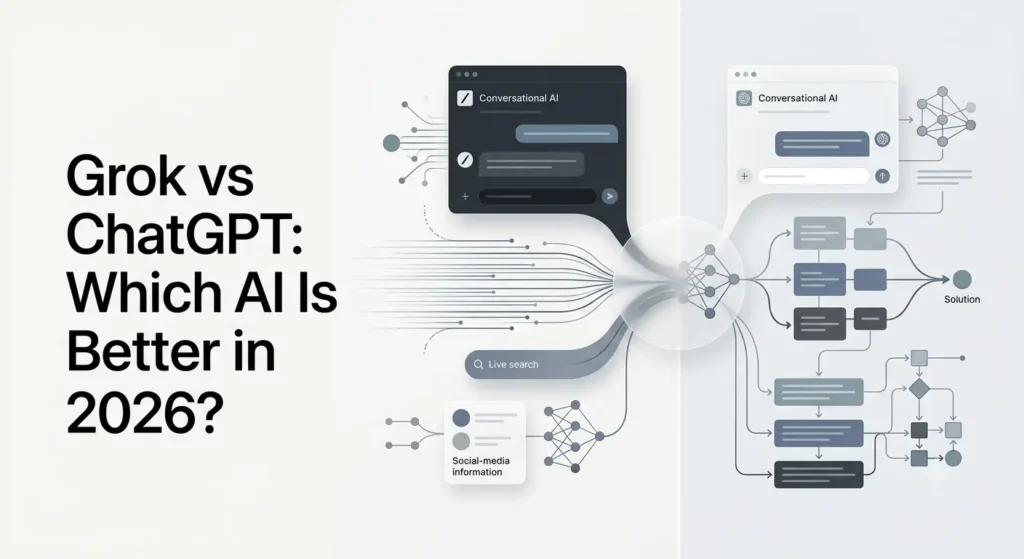
Grok vs ChatGPT is no longer a simple comparison between two general-purpose AI chatbots. Both platforms can reason, code, analyze files, search the web, generate images, and handle increasingly complex multi-step tasks. The bigger difference is how each ecosystem approaches those capabilities.
Grok stands out for its connection to real-time web and X search, fast conversational interaction, and xAI’s latest Grok models. ChatGPT, meanwhile, has increasingly emphasized reasoning depth, professional workflows, coding, research, file analysis, and tool-based work.
The comparison is largely between Grok 4.6 and OpenAI’s GPT-5.6 generation, although the exact model available depends on the user’s plan and the task. xAI describes Grok 4.6 as its flagship model for long-running agents, interactive work, visual tasks, coding, and knowledge work.
Quick Summary
- Grok stands out for real-time web and X search, making it useful for breaking news, trends, and current discussions.
- ChatGPT focuses strongly on deep reasoning, research, coding, file analysis, and professional workflows.
- Grok 4.6 and GPT-5.6 both offer advanced reasoning, coding, agentic capabilities, and multimodal features.
- Grok is a strong choice for real-time information and X-centric research, while ChatGPT is better suited to complex analysis and structured work.
- For power users, combining Grok for discovery with ChatGPT for deeper analysis can be an effective workflow.
Grok vs ChatGPT: What’s the Difference?
Grok and ChatGPT are both AI assistants, but they have developed different strengths.
Grok is closely integrated with the X ecosystem and emphasizes access to current information through real-time web and X search. Its current flagship, Grok 4.6, is designed for long-running agents, interactive and visual work, coding, research, and knowledge work.
ChatGPT is built as a broader productivity and reasoning environment. OpenAI’s current GPT-5.6 generation supports different reasoning levels and is designed for complex knowledge work, coding, analysis, and agentic workflows.
That distinction matters because choosing between them should depend less on which chatbot produces the flashiest answer and more on what type of work you do most often.
| Category | Grok | ChatGPT |
|---|---|---|
| Current flagship | Grok 4.6 | GPT-5.6 generation |
| Real-time information | Strong web + X integration | Strong web/research capabilities |
| Social/current-events context | Particularly strong through X | Strong, but different ecosystem |
| Reasoning | Configurable reasoning on supported models | Multiple reasoning levels/options |
| Coding | Strong, especially agentic workflows | Strong, with Codex and advanced coding workflows |
| Long-running tasks | Grok 4.6 emphasizes agentic work | Strong agentic and professional workflows |
| Image generation | Available through Grok | Available through ChatGPT |
| File analysis | Available | Extensive file-analysis workflows |
| Research | Strong with live information | Strong with deep research and reasoning |
| Best fit | Real-time information, X, interactive tasks | Reasoning, research, productivity, coding |
The important caveat is that features, model availability, and usage limits can vary by plan and change over time.
Is Grok Faster Than ChatGPT?
Grok can feel faster in many conversational and real-time-information workflows, but there is no universal rule that Grok is faster than ChatGPT. Response speed depends on the model, reasoning effort, server load, task complexity, tools being used, and subscription tier.
xAI currently markets Grok 4.6 for ambitious interactive work and long-running agents, while its pricing page specifically highlights “lightning-fast replies” for SuperGrok Plus.
ChatGPT also offers faster-response modes. OpenAI describes its current GPT-5.6 system as combining efficient default behavior with additional intelligence when more capability is needed. ChatGPT Plus also advertises faster response speeds compared with Free.
So instead of asking “Which AI is fastest?”, a better question is:
Which AI reaches a useful answer fastest for my particular workflow?
For a quick question about something happening on X right now, Grok’s access to real-time X information can make it especially convenient.
For a complicated analysis requiring multiple steps, documents, structured reasoning, or tool use, ChatGPT may spend more effort before producing the final answer—and that can be more valuable than simply responding first.
Grok’s Biggest Advantage: Real-Time Information
One of Grok’s clearest differentiators is its connection to real-time web and X search.
The current Grok plans explicitly list real-time web + X search as a feature.
This is particularly useful for topics that change quickly:
- Breaking technology news
- AI model releases
- X discussions and reactions
- Current product updates
- Live online trends
- Recent announcements
- Public conversations around companies or products
Imagine you want to know what developers are saying about a newly released AI model. A conventional knowledge-based answer may not capture the latest discussion. Grok’s access to X can provide an additional layer of current context.
That does not mean everything Grok retrieves from X is automatically accurate. Social media contains rumors, speculation, outdated posts, jokes, and incorrect claims. Real-time access increases freshness, but it does not eliminate the need for verification.
For journalism, SEO research, market monitoring, and trend analysis, this distinction is important.
ChatGPT’s Biggest Advantage: Deep Reasoning and Structured Work
ChatGPT’s strength is increasingly less about simply answering questions and more about working through complex tasks.
OpenAI’s GPT-5.4 release emphasized reasoning, coding, knowledge work, computer use, tool use, and agentic workflows. GPT-5.6 subsequently extended OpenAI’s focus on professional and demanding workloads.
Current ChatGPT reasoning options can be useful for:
- Multi-step problem solving
- Complex research
- Data analysis
- Coding and debugging
- Document analysis
- Planning
- Writing and editing
- Professional knowledge work
- Agentic tasks
OpenAI also describes GPT-5.6 Sol as offering different reasoning levels, allowing users to choose how much thought the system puts into a response.
This creates an important difference in philosophy.
Grok’s real-time capabilities make it particularly attractive when fresh information is the problem.
ChatGPT’s reasoning ecosystem is particularly attractive when complexity is the problem.
Of course, the two categories overlap heavily.
Grok 4.6 vs GPT-5.6
The current generation makes older comparisons such as “Grok 3 vs GPT-4o” increasingly irrelevant.
| Feature | Grok 4.6 | GPT-5.6 |
|---|---|---|
| Introduction | xAI introduced Grok 4.6 in August 2026. | OpenAI introduced GPT-5.6 in July 2026. |
| Positioning | Evolution of Grok 4.5 focused on long-running agents, interactive work, visual tasks, research, information analysis, codebases, and application creation. | Frontier model designed to scale intelligence for demanding professional and knowledge-intensive work. |
| Key Focus Areas | Long-running agents, research, information analysis, coding, interactive experiences, visual work, and application building. | Knowledge work, design, coding, science, cybersecurity, and performance per dollar. |
| Context Window | 500K tokens | Not specified in the provided information |
| API Pricing | $2 / 1M input tokens and $6 / 1M output tokens | Not specified in the provided information |
| Developer & Enterprise Availability | Available across multiple developer and enterprise platforms. | Available through OpenAI’s ecosystem and ChatGPT. |
| Third-Party Platforms | Announced for Amazon Bedrock and Gemini Enterprise Agent Platform in August 2026. | Not specified in the provided information |
| ChatGPT Updates | — | GPT-5.6 Sol was updated in ChatGPT with more focused answers, improved factual reliability, and more consistent quick/deep responses. |
| Free Access | — | OpenAI expanded GPT-5.6 Luna access for free users. |
| Best Suited For | AI agents, research, coding, visual work, application building, and complex interactive tasks. | Knowledge work, coding, design, science, research, and demanding professional tasks. |
| Overall Direction | Moving from chatbot interactions toward long-running agents and application creation. | Moving from chatbot responses toward performing complex knowledge and professional work. |
Practical takeaway: Both Grok 4.6 and GPT-5.6 represent a shift from traditional chatbot-style AI toward models designed to perform multi-step work, build things, analyze information, and handle more demanding tasks.
Which Is Better for Real-Time Search?
Grok has the edge when X matters
If your research depends heavily on what people are discussing on X, Grok has a structural advantage because xAI explicitly integrates X search into its product experience.
This can be valuable for:
- Tracking AI announcements
- Monitoring reactions to product launches
- Finding emerging discussions
- Researching public sentiment
- Following technology communities
- Discovering breaking developments
For example, an AI news writer researching a newly announced model could use Grok to quickly identify the announcement, related X discussions, developer reactions, and emerging questions.
However, important claims should still be checked against primary sources.
ChatGPT is strong for research synthesis
ChatGPT is better suited to workflows where the goal isn’t simply finding current information but turning information into a structured result.
A researcher might use it to:
- Gather information.
- Compare multiple sources.
- Identify contradictions.
- Organize the findings.
- Analyze supporting documents.
- Produce a report or strategy.
- Refine the result through additional reasoning.
That difference is subtle but important.
Search is about finding information. Reasoning is about doing something useful with it.
Modern AI assistants increasingly need to do both.
Which Is Better for Coding?
Both Grok and ChatGPT are serious coding tools in 2026.
Grok 4.5 and 4.6 have been explicitly positioned around coding and agentic software development. xAI describes Grok 4.6 as suitable for working across a codebase and long-running tasks.
Grok 4.6 is also available through GitHub Copilot, giving developers another way to use the model inside established development workflows.
ChatGPT has an equally strong coding ecosystem. OpenAI’s GPT-5.4 release specifically highlighted coding, tool use, software environments, and agentic workflows, while Codex provides a dedicated coding-agent environment.
a) For simple coding
Both are capable of:
- Generating functions
- Explaining code
- Fixing errors
- Writing SQL
- Creating scripts
- Converting code between languages
b) For large projects
The difference becomes more about the surrounding tools and workflow.
ChatGPT may be preferable if your workflow already depends on:
- Codex
- File analysis
- Structured reasoning
- Long-form planning
- Documentation
- Multiple connected tools
Grok may be particularly attractive if you want:
- xAI models
- Agentic coding
- Real-time information
- GitHub Copilot integration
- A workflow connected to the broader X/xAI ecosystem
There is no reliable reason to declare one universally superior for every programming language or project.
Which is Better for Writing?
For ordinary writing, both are capable enough that the model itself is often less important than the prompt and editing workflow.
ChatGPT is particularly useful for
- Long-form articles
- Editing
- Rewriting
- Research-backed drafts
- Structured reports
- Professional documents
- Content planning
- Iterative revisions
Grok is particularly useful for
- Current-event writing
- Trend-based content
- X-oriented commentary
- Rapid research
- Social-media context
- Content requiring fresh online information
For a technology publisher, the two can complement each other.
For example:
Grok: Find what is being discussed right now.
ChatGPT: Analyze the information, organize it, challenge weak claims, and turn it into a structured article.
That workflow can be more effective than treating the comparison as a winner-takes-all contest.
Which Is Better for Image Generation?
The comparison is also no longer limited to text.
Grok’s current SuperGrok plans include image and video generation, while ChatGPT also offers image generation as part of its broader AI workspace.
The better choice depends heavily on the exact creative task.
For example, a creator may care about:
- Prompt adherence
- Character consistency
- Editing controls
- Text rendering
- Style control
- Image quality
- Video generation
- Generation limits
- Editing workflow
Because these capabilities change quickly, image-generation comparisons should be tested against the current models, rather than relying on old reviews.
Grok vs ChatGPT for Research
This is one of the most interesting comparisons.
i) Choose Grok when freshness is the priority
Grok’s real-time web and X access makes it useful when the answer depends on what is happening right now.
Examples:
“What are developers saying about this new AI release?”
“What is trending around this company on X?”
“What reactions appeared after today’s announcement?”
ii) Choose ChatGPT when synthesis is the priority
ChatGPT becomes particularly useful when you already have substantial information and need to reason through it.
Examples:
“Compare these five product announcements and identify the meaningful differences.”
“Analyze this 100-page report and explain the implications.”
“Turn these research notes into a structured market analysis.”
The distinction can be summarized as:
Grok is particularly strong at freshness. ChatGPT is particularly strong at synthesis and structured reasoning.
Neither description should be treated as an absolute performance ranking.
Grok vs ChatGPT Pricing
Pricing changes frequently, so subscription prices should always be checked before purchasing.
As of September 2026, xAI’s official consumer pricing page lists SuperGrok at $30/month and SuperGrok Plus at $100/month. The SuperGrok tier includes Grok 4.6, higher rate limits, connectors, Expert, and image/video generation. SuperGrok Plus adds significantly higher usage, 1080p video creation, priority access, and early access to features.
OpenAI’s consumer plans include ChatGPT Go, Plus, and Pro. OpenAI lists Plus at $20/month and Pro at $200/month in its global plan announcement; OpenAI’s current Help Center also documents a $100 Pro tier alongside the $200 tier. Regional pricing can differ.
| Plan | Grok | ChatGPT |
|---|---|---|
| Free access | Yes | Yes |
| Main paid tier | SuperGrok — $30/month | Plus — $20/month |
| Higher tier | SuperGrok Plus — $100/month | Pro — $100/$200 tiers |
| Current flagship | Grok 4.6 | GPT-5.6 generation |
| Real-time X search | Yes | No X integration equivalent |
| Reasoning options | Available on supported Grok models | Available through current reasoning options |
| Image generation | Yes | Yes |
| Video generation | Yes | Available through ChatGPT’s evolving media features |
| Coding tools | Yes | Yes, including Codex |
| API | Separate usage-based pricing | Separate usage-based pricing |
Prices and included features can change, and regional billing may differ.
For developers, the API comparison is different from consumer subscriptions. xAI currently lists Grok 4.6 at $2 per million input tokens and $6 per million output tokens, while OpenAI’s enterprise rate card lists different GPT-5.6 rates depending on model and reasoning level. API pricing should therefore be compared model-to-model rather than by chatbot subscription price.
Which AI Is Better for Marketers?
For marketers, the answer depends on the type of marketing work.
1. Grok can be valuable for
- Trend discovery
- X monitoring
- Current-event research
- Audience conversations
- Competitor discussion monitoring
- Social content ideas
- Fast information discovery
2. ChatGPT can be valuable for
- SEO content planning
- Content briefs
- Keyword clustering
- Long-form writing
- Data analysis
- Campaign planning
- Spreadsheet analysis
- Email copy
- Conversion-focused content
- Marketing strategy
A marketer who spends significant time monitoring X may get more practical value from Grok.
A marketer managing content strategy, analytics, research, and documentation may prefer ChatGPT.
For many professionals, using both can make more sense than choosing only one.
Which AI Should Developers Choose?
Developers should evaluate the entire workflow rather than only model benchmarks.
Choose Grok if your priorities include:
- Real-time information
- X ecosystem access
- Grok 4.6
- Agentic coding
- GitHub Copilot integration
- xAI API development
Choose ChatGPT if you prioritize:
- Deep reasoning
- Codex
- Complex debugging
- Documentation
- File analysis
- Agentic workflows
- Broad productivity tools
xAI’s current API documentation lists Grok 4.6 with a 500K context window, while some newer Grok 4.20 developer models are documented with a 1-million-token context window. This illustrates why model-specific comparisons are more useful than simply comparing the Grok and ChatGPT brands.
What Are the Limitations of Grok?
Grok’s real-time access is a major advantage, but it also creates an important limitation: fresh information is not automatically trustworthy information.
Potential issues include:
- Social-media misinformation
- Rumors and speculation
- Conflicting reports
- Context missing from short posts
- Rapidly changing information
- Incorrect user-generated claims
The same fundamental AI limitations apply as well: generated answers can still contain errors.
For important research, verify claims against primary sources.
What Are the Limitations of ChatGPT?
ChatGPT is not immune to the same fundamental problems.
Potential limitations include:
- Incorrect answers
- Hallucinated facts
- Outdated information when current search isn’t used
- Usage limits depending on the plan
- Different model availability across tiers
- Reasoning taking longer on difficult tasks
- Tool availability changing over time
ChatGPT’s reasoning capabilities can produce substantially better results on difficult problems, but more reasoning does not guarantee correctness.
The right workflow remains AI assistance plus verification, especially for financial, legal, medical, technical, and business-critical information.
Grok vs ChatGPT: Which One Should You Choose?
There isn’t one answer for everyone.
a) Choose Grok if you:
- Follow X heavily.
- Need current online information.
- Track technology trends.
- Research breaking news.
- Want real-time web and X search.
- Prefer Grok’s ecosystem.
- Want access to Grok 4.6 and xAI’s developer platform.
b) Choose ChatGPT if you:
- Need deep reasoning.
- Write or analyze long documents.
- Work with code regularly.
- Use AI for professional workflows.
- Need structured research.
- Want Codex and broader productivity tools.
- Frequently analyze files and data.
c) Choose both if you:
- Work professionally with AI.
- Produce technology or market research.
- Need both real-time discovery and deep analysis.
- Develop software while researching current technical information.
- Create content for multiple platforms.
For many power users, Grok and ChatGPT are better viewed as complementary tools than direct replacements for each other.
A Practical Grok + ChatGPT Workflow
One of the most useful ways to approach the Grok vs ChatGPT debate is to divide the work.
Step 1: Discover with Grok
Use Grok to investigate:
- What happened recently?
- What are people discussing?
- What is trending?
- What questions are emerging?
- What are developers saying?
Step 2: Verify the important claims
Check major claims against:
- Official announcements
- Documentation
- Company blogs
- Research papers
- Regulatory filings
- Direct statements
Step 3: Analyze with ChatGPT
Give ChatGPT the verified material and ask it to:
- Identify important differences
- Find contradictions
- Organize the evidence
- Explain technical concepts
- Build a structured outline
- Analyze implications
Step 4: Produce the final output
Use whichever system fits the final format:
- Article
- Report
- Strategy
- Code
- Presentation
- Social content
- Research summary
This approach separates information discovery from reasoning and production.
Is Grok Better Than ChatGPT?
Grok is not universally better than ChatGPT, and ChatGPT is not universally better than Grok. Grok has a particularly strong position when real-time information, X search, and current online conversations are central to the task. ChatGPT is particularly strong for deep reasoning, structured analysis, coding, research, and professional workflows.
The best choice depends on what you value most: freshness, reasoning depth, tools, ecosystem, price, or workflow integration.
Final Verdict – Grok vs ChatGPT: Which AI Is Better in 2026?
The most useful way to understand Grok vs ChatGPT is not “fast AI versus smart AI.” Both platforms are fast, and both can reason.
The more meaningful difference is where each platform creates the most leverage.
Grok’s strongest identity is tied to real-time information, X, web search, interactive experiences, and xAI’s agentic model development. Grok 4.6 has also moved firmly into complex coding, research, visual, and long-running tasks.
ChatGPT has evolved into a broader reasoning and productivity platform, with GPT-5.6, multiple reasoning levels, coding agents, research capabilities, file analysis, and professional workflows.
So the practical verdict is simple: Pick Grok for real-time context and X-centric research. Pick ChatGPT for deep reasoning and structured work. Use both when your workflow requires current information followed by serious analysis.
Frequently Asked Questions
1. Is Grok better than ChatGPT?
Grok is particularly strong for real-time web and X information, while ChatGPT is particularly strong for reasoning, research, coding, and structured professional workflows. Neither is universally better.
2. Is Grok faster than ChatGPT?
Grok can feel faster in certain real-time and conversational workflows, but there is no universal speed winner. Response time depends on the model, reasoning level, tools, server conditions, and task complexity.
3. Which is better for coding, Grok or ChatGPT?
Both are strong coding assistants. Grok 4.6 emphasizes agentic coding and long-running tasks, while ChatGPT offers advanced reasoning and Codex-based coding workflows. The better option depends on the developer’s preferred environment.
4. Which is better for real-time information?
Grok has a major advantage when X content is important because xAI explicitly provides real-time web and X search. ChatGPT can also perform current-information research, but its workflow and information sources are different.
5. Is Grok cheaper than ChatGPT?
It depends on the plan. xAI currently lists SuperGrok at $30/month, while OpenAI lists ChatGPT Plus at $20/month. However, features, usage limits, regional pricing, and higher tiers differ, so subscription price alone does not determine value.
6. Can I use Grok and ChatGPT together?
Yes. A practical workflow is to use Grok for current information and X-based discovery, then use ChatGPT for deeper analysis, organization, writing, coding, or other downstream work.
Also Read –
Grok 4.6 AI Guide: Everything About Its Features, Pricing, Benchmarks and Availability
SuperGrok Pricing & Features: A Complete Guide (2026)
SuperGrok vs ChatGPT Plus: How to Pick the Best AI Subscription?