
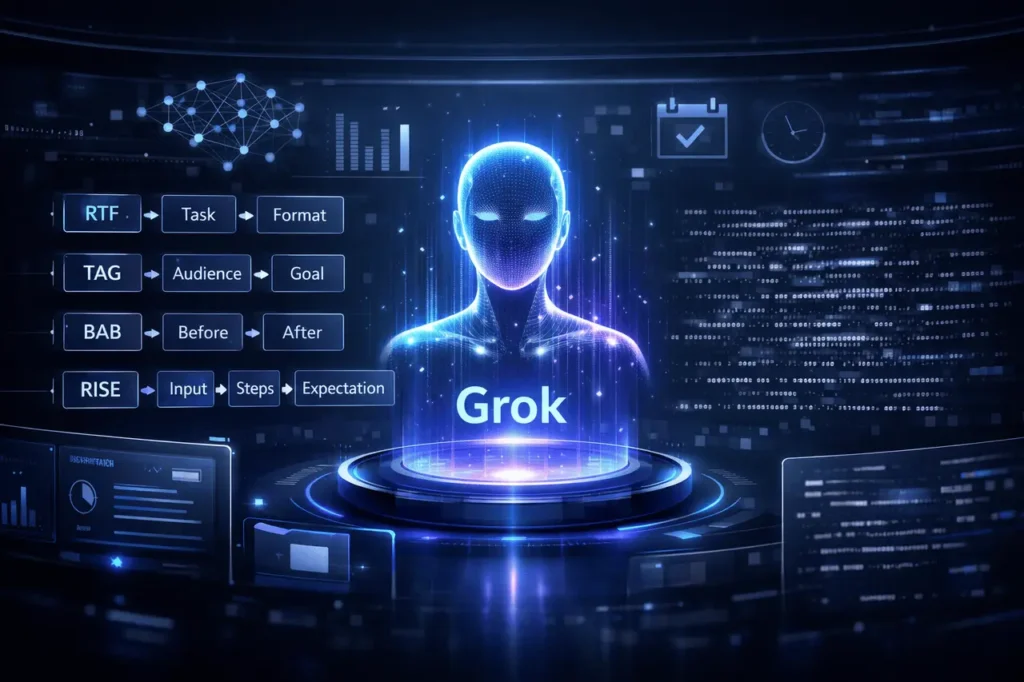
As the use of generative AI is integrated into daily processes, the quality of the results will depend on the way users interact with the systems. Recent discussions within the AI community reveal the growing consensus that unclear prompts can lead to ambiguous results, whereas structured prompts consistently produce superior outcomes. This trend is evident in Grok users, which is why prompt frameworks like R-T-F T-A-G, B.A.B and R-I S-E are enjoying acceptance rapidly.
These frameworks turn prompting from a casual experiment into a repeatable and professional expertise. Instead of thinking of AI as a simple chatbot, users are starting to think of it as a tool for productivity, one that is responsive to clarity, intention and organisation.
This article describes the reasons Grok prompt frameworks are essential, how they function, and how implementing them can significantly improve the accuracy, quality, and utility of AI-generated outputs.
What Is Grok?
Grok is an artificial intelligence-based assistant designed through xAI that is incorporated into the X platform. It was designed to assist users in producing content, analysing data, addressing complicated questions, and aiding in tasks like researching, coding, or writing. Contrary to chatbots that are merely chatbots, Grok is advertised as an AI designed for productivity, and it performs best when provided with precise, well-structured instructions.
Grok is a tool that focuses on the importance of contextual understanding and step-by-step reasoning, making it highly effective for technical and professional use instances. When paired with structured prompt frameworks, Grok is able to provide more precise, valuable, actionable, and relevant outputs, making it an application for conversation to an effective assistant for real-world work.
Why Prompt Quality Matters More Than the Model?
AI systems can’t “think” like humans. AI systems interpret patterns, contexts and directions according to the information they receive. If an instruction is unclear, undefined or too broad, the system has to make guesses about the user’s intentions. The guesswork can result in inadequate or generic responses.
A lot of users believe that weak responses are a sign of a weakness in an AI model. In reality, the most common bottleneck is the prompt. The structured prompting frameworks solve this issue by eliminating doubt and guiding the AI towards the desired result from the beginning.
With Grok becoming more prominently positioned as a tool used for research and analysis, programming, and even content creation, rapid quality is now an advantage over competitors rather than just a nice-to-have it.
What Are Grok Prompt Frameworks?

Frameworks for prompts have predefined patterns which help users logically arrange their instructions. As opposed to writing the prompts on the spot, they follow a standard structure that ensures that all crucial components are in place.
The most frequently used frameworks that Grok users use are:
- R-T-F (Role-Task-Format)
- T-A-G (Task-Audience-Goal)
- B-A-B (Before-After-Bridge)
- R-I-S-E (Role-Input-Steps-Expectation)
Each framework is used for an individual purpose, and all share the same objective: increasing clarity and reducing confusion.
R-T-F: Role, Task, Format
R-T-F is among the most widely used frameworks and is particularly suitable for technical and professional outputs.
- Role: Determine who AI will be acting as
- Task: Define precisely the task to be performed.
- Format: Indicate how the output should be organised
The framework works because it establishes context before requesting actions. By defining the role, users restrict the AI’s vision. The role narrows the field, and the format eliminates the uncertainty about the presentation.
Best for: Reports, tutorials, technical explanations, professional writing.
T-A-G: Task, Audience, Goal
T-A-G shifts focus toward communication effectiveness.
- Aufgabe: What should the AI be able to produce
- Public: For whom is this content aimed?
- The goal: The desired outcome
In stating the purpose and audience explicitly, Users can aid Grok in adjusting the tone, depth and complexity. This is especially useful when writing for less technical audiences or executives, as well as specific users.
Best for: Marketing content, educational material, product explanations.
B-A-B: Before, After, Bridge
B-A-B is an illustrative framework that can excel in engaging and informative contexts.
- In the beginning: Describe the present problem or situation
- Following: Define the desired future state
- Bridge: Explain the steps to make it easier to transition from before to after
This structure echoes the classic storytelling techniques, making outputs more enjoyable and solution-oriented. Grok is well-suited to this structure when clarity about the transformation process is required.
Best for: Case studies, sales copy, change management, problem-solving content.
R-I-S-E: Role, Input, Steps, Expectation
R-I-S-E is the most comprehensive framework available and is commonly used to perform complex tasks.
- Role: This is the view that AI should adopt. AI must adopt
- Input: Background data or constraints
- Steps: A simple procedure to follow
- Expectation: Achieving requirements in production
This framework reduces confusion by guiding not just how the AI should perform, but also how it will think about the job. It is invaluable in situations where accuracy and consistency are crucial.
The best for data analysis and strategic planning are Multi-step reasoning tasks.
Why These Frameworks Are Going Viral?
Tangible advantages fuel the rapid acceptance of Grok’s quick frameworks:
- Better Output Quality: Responses are more relevant, organised and can be taken into action.
- Clear prompts: cut down on the need for corrections that follow up.
- Performance: Users have less time to refine outputs by hand.
- Skill Transferability: When you’ve learned frameworks, they can be applied to multiple AI instruments.
The most important thing is that these frameworks shift responsibility to the individual user. Instead of accusing AI of poor responses, users can refine their inputs – an attitude shift that can lead to always better results.
Grok prompt frameworks: Prompting as a Professional Skill
The ability to prompt isn’t just an experiment in itself. In many businesses, it is becoming a necessity to communicate using AI systems effectively, which is now an essential productivity tool. People who are early adopters of the art of structured prompting will gain a benefit in terms of speed, clarity, and output performance.
To Grok clients, frameworks work as an increaser of force. They allow the system to give responses that feel deliberate instead of merely responsive, which makes Grok not a chatbot but more of a tool for collaboration.
Final Thoughts
The growth of Grok prompt frameworks is an evolution in the way humans communicate with AI. As AI models get more advanced, the main issue is now more human input than machine learning. Frameworks such as R-T-F, T.A.G B-A, R-I S-E, and T-A-F offer simple, yet effective methods of bridging that gap.
With the help of structured prompting, users are able to move away from trial-and-error and towards reliable, high-quality results. In an environment where clarity and efficiency are essential, prompt frameworks aren’t an option; they are required.
Frequently Asked Questions
1. Can Grok prompt frameworks be appropriate for beginners?
Yes. The frameworks have been created to be simple and easy to use, making them appropriate for those without prior knowledge.
2. What framework should I begin with?
R-T-F is an excellent starting point because of its simplicity and adaptability to a variety of use situations.
3. Are these frameworks just useful only for Grok?
No. Although extensively utilised by Grok users, the frameworks can be ported to modern AI systems.
4. Do prompts with structured structure hinder the creativity of students?
The structured prompts provide direction, but don’t limit creativity. They often improve creativity by providing more precise instructions.
5. How is the length of a prompt in a framework?
The length of the prompt is not as crucial as its clarity. A short but clear message that is based on a framework can be more effective than a lengthy, unstructured prompt.
6. Can frameworks be used together?
Yes. Advanced users typically combine elements of multiple frameworks to meet the demands of complicated or special needs.
Also Read –
Grok Prompt Frameworks: How Structured Prompts Improve AI Results?
How to Write Effective Prompts for SuperGrok: A Comprehensive Guide
How to Edit Images on X Using Grok: A Complete In-App Guide (2026)