
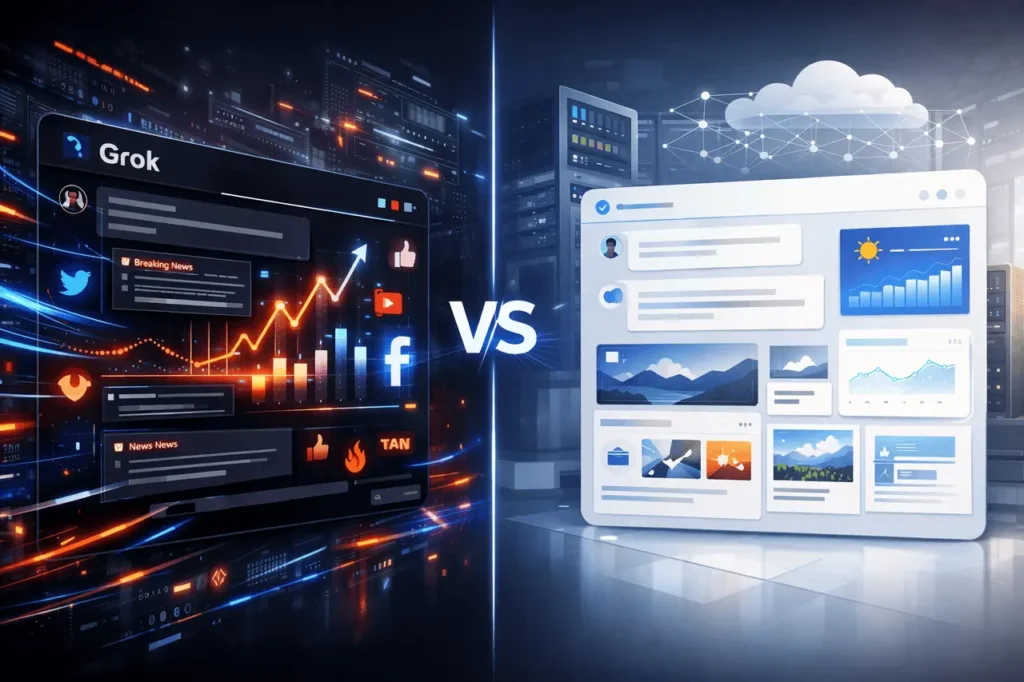
The consumer AI chatbot market is entering an era where habit formation is more important than raw model capabilities. Users aren’t just experimenting but are deciding on which chatbot to use each day. In this sense, Grok has emerged as an essential competitor to Gemini, with increasing signs that users are actively choosing Grok for use in everyday life.
The shift in behaviour is not caused by one characteristic. It is more a reflection of the different perspectives of each product and the access to information, platforms integration and the speed of development. In this article, we explore Grok vs Gemini, the main factors that influence the reasons Grok adoption is growing rapidly and also the reason Gemini is, in spite of its solid technological foundation, struggling with issues with user retention.
Daily Active Usage: The Metric That Matters Most
In the world of consumer software, the number of daily active users (DAU) is a more precise gauge of the app’s success than registrations or downloads. Recent trends and app store analyses of the U.S. market during late 2024 and 2025 suggest that Grok’s usage per day has increased rapidly in comparison to Gemini.
The key here is that it’s behavioural and not only numerical. People seem to be deliberately selecting Grok as their AI partner, which suggests greater perception of its value and importance in their daily routines, particularly for news, social context and in real-time conversations.
Grok vs Gemini: App Ratings and User Sentiment
Ratings from users can provide a different perspective to gauge the quality of adoption. In the major app stores for mobile, Grok holds one of the highest ratings in popular AI chat applications, hovering close to the top of the list. High ratings typically indicate:
- Lower friction during daily use
- Rapider response to feedback from the user
- The feeling is that it’s a product that “keeps evolving”
However, the ratings of Gemini show a mixed response. Although many users appreciate the technical accuracy of Gemini and its integration in Google services, the constant feedback indicates prudent responses and limits the flexibility of conversations.
Grok vs Gemini: Real-Time Data as a Differentiator
One of Grok’s most significant advantages is its ability to be aware in real-time of conversations, events and discussions. Because of its extensive integration in X, Grok can respond immediately to social and cultural contexts that slow or static databases are unable to match.
This feature is crucial because current AI users are increasingly asking questions related to:
- Breaking news
- Live market reactions
- Current debates and memes
Gemini, a browser with better security features and more robust data pipelines, is usually just a few steps away from the live web and could limit its use for queries that are time-sensitive.
Grok vs Gemini: Product Philosophy: Speed vs Structure
The distinction in Grok and Gemini is also a philosophical one.
Grok represents a quick approach to iterating in public, which is in line with xAI’s larger strategy. The updates are frequent, the new features develop quickly, and the app frequently feels untested; however, it is alive.
Gemini, created within Google’s enterprise-scale ecosystem, is a system that focuses on :
- Compliance
- Risk mitigation
- Cross-product consistency
Although this method minimises the risk of adverse consequences, it also makes the product appear stiff as well as “over-filtered” to people who want a smooth, natural conversation.
Grok vs Gemini: Infrastructure Investment and Talent Focus
The primary driver for Grok’s growth is the continued investment. Elon Musk has publicly emphasised increasing the size of compute, bringing on staff, while also vertically merging infrastructure to help the xAI roadmap.
This investment is reflected in:
- Faster model refresh cycles
- Improved latency
- The rapid deployment of the latest capabilities
Gemini is a benefit of Google’s extensive infrastructure; however, its development schedule is spread across multiple internal priorities. This can delay visible changes for consumers.
Why Grok Feels More “Connected” to Users?
For a lot of customers, Grok feels less like an actual productivity tool and more like a virtual partner that is tuned to the internet. This perception is based on:
- Informal conversational tone
- Be aware of the latest trends in topics
- A lesser number of interruptions to safety disclaimers in harmless contexts
Gemini, although highly efficient, can be a little sluggish at times. It was created for institutional correctness first, and user-generated spontaneity later. As time passes, that distinction determines the apps that users are naturally able to use.
Adoption Momentum and Network Effects
As more users embrace Grok within the X ecosystem, the network effects start to increase the use. Conversations on X bring questions to Grok, and Grok’s replies often refer to the information users get in their feeds.
This loop is a powerful force for the formation of habits. Gemini is more of an individual assistant that spans throughout Google properties, and does not have one social nucleus that drives similar growth.
What This Means for the AI Chatbot Market?
The Grok vs. Gemini dynamic reveals a larger trend: people value relevance and immediateness more than pure intelligence. The best devices are current and responsive, as well as compatible with how users consume information.
This doesn’t mean Gemini is slipping away irreparably. Google’s capabilities in the areas of productivity, search, and multimodal AI remain powerful. However, the growth of Grok’s product indicates that the preferences of users will change rapidly when an AI-based product is more in tune with digital lifestyles.
My Final Thoughts
Grok’s increasing popularity is not an accidental event. It is a result of deliberate decisions about the real-time information platforms, platform integration, and quick iteration. Gemini is a robust and reliable companion; however, its less stout design has allowed Grok to attract users who want instantaneity and authenticity.
As AI assistants evolve into tools that are used regularly instead of novelties, the battle will be decided by the tools that users choose to open each morning. For the moment, Grok appears to be winning the daily choice for a growing portion of users.
Frequently Asked Questions
1. Is Grok, in fact, much more popular than Gemini?
The indicators of user engagement within the U.S. suggest Grok’s daily usage is increasing quickly, signalling an increase in popularity among consumers, although the level of popularity varies according to region.
2. Why do people say Grok is better “Real-Time “?
Grok’s integration with X allows it to record ongoing discussions and break topics quickly than assistants that rely on static data pipelines.
3. Does Gemini offer better AI capabilities?
Gemini is mighty, particularly for the context of structured tasks and productivity instances; however, some users may find their responses more restricted in casual conversations.
4. Is Grok secure enough to use for your everyday inquiries?
Yes. Grok has safety features. However, it is specifically designed to reduce friction during non-sensitive conversations.
5. Will Gemini get ahead of users in adoption?
Google is continuing to upgrade Gemini, and any changes to features or integrations may influence future trends of adoption.
6. Which AI assistant is more effective all-around?
It’s dependent on the requirements of the user. Grok has an excellent record in real-time context and conversational flow, whereas Gemini excels in precision productivity, efficiency, and integration into ecosystems.
Also Read –