
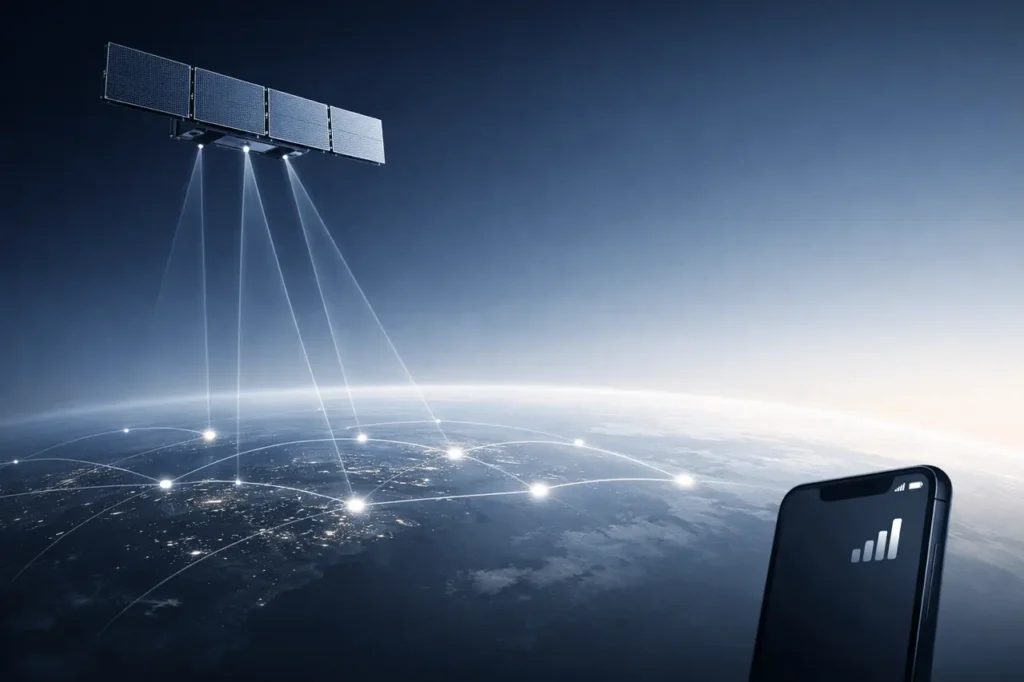
Starlink Mobile V2 satellites represent an important leap in satellite-to-phone connectivity, delivering 5G speeds directly from space to smartphones. Starlink announced the new-generation device: it is designed and built to operate similarly to a terrestrial cellular tower, but from space.
With significantly higher data density, advanced phased-array antennas, and a custom silicon chip designed by SpaceX, Mobile V2 aims to extend high-speed mobile coverage into areas where traditional communications infrastructure has struggled or been unable to reach.
What Are Starlink Mobile V2 Satellites?
Starlink Mobile V2 satellites are the next step in Starlink’s direct-to-cell architecture. Unlike traditional fixed-satellite Internet terminals, which require specialised hardware, Mobile V2 connects directly to a regular LTE or 5G smartphone, with no additional equipment required.
The system makes use of:
- Custom SpaceX-designed silicon
- High-end phased-array systems for antennas
- Many thousands of spatial beams that are dynamic and dynamic
- Increased throughput by a significant amount per satellite
According to the Starlink announcement, Mobile V2 satellites can offer:
- 100x the data density of V1 satellites
- 20x the capacity in the first-generation satellites
These updates enable the system to offer real 5G-like performance from space.
How Starlink Mobile V2 Delivers 5G From Space?
1. Direct-to-Cell Technology
Traditional satellite phones need specialized hardware. Mobile V2 is a substitute for current cellular standards that allow normal smartphones to connect as they would to ground-based towers.
The most significant innovation is in:
- Spectrum reuse
- Beamforming by phased-array antennas
- Integration at the network level with the telecom partner
From a user’s perspective, the experience is similar to terrestrial coverage.
2. Thousands of Spatial Beams
Mobile V2 satellites produce thousands of highly managed spatial beams. Each beam acts as a micro-cell tower and dynamically allocates bandwidth based on demand.
This architecture can:
- Efficient spectrum usage
- Lower latency in comparison to older satellite systems
- More data processing
3. Custom SpaceX Silicon
Satellites contain exclusive silicon that has been optimized to:
- Signal processing
- Beam steering
- Power efficiency
This vertical integration enables more efficient coordination between software and hardware and better network performance.
Key Technical Improvements: V1 vs V2
| Feature | First-Gen (V1) | Mobile V2 |
|---|---|---|
| Data Density | Baseline | 100× higher |
| Throughput | Standard LEO capacity | ~20× higher |
| Beam Capacity | Limited spatial beams | Thousands of beams |
| Device Support | Fixed terminals + limited direct-to-cell | Direct to existing smartphones |
| Performance Goal | Basic messaging + limited data | Real 5G-like speeds |
These improvements mark a shift away from low-bandwidth or emergency satellite connectivity toward high-quality mobile internet access.
What Real 5G From Orbit Means for Users?
Starlink Mobile V2 is created to work with:
- Lightning-fast video streaming
- Smooth web browsing
- Real-time apps
- Crystal-clear voice calls
- Video calls with high-quality
- Email and messaging
It is important to recreate the experience of 5G terrestrial coverage.
They could alter the connectivity of:
- Remote and rural regions
- Forested or mountainous regions
- Maritime environments
- Disaster-stricken zones
- Regions that do not have a telecom infrastructure
Current Coverage and Expansion Plans
Starlink claims to operate in more than 32 countries, covering more than 1.7 billion people. Starlink can support:
- 40+ applications
- 100+ device types
Mobile V2 is anticipated to extend this technology’s reach further, covering areas previously considered technically inaccessible to conventional cellular towers.
Why This Is a Massive Shift for the Telecom Industry?
The advent of space-based 5G coverage poses a challenge to traditional communications models.
Traditional Cellular Model
- Capital-intensive tower construction
- Dense infrastructure in urban areas
- Sparse coverage in rural regions
- The vulnerability to natural catastrophes
Space-Based Cellular Model
- Orbiting satellite constellations
- Rapid deployment
- Wide-area coverage
- Resilient infrastructure
| Aspect | Terrestrial Networks | Starlink Mobile V2 |
|---|---|---|
| Infrastructure | Physical towers | Low Earth Orbit satellites |
| Coverage Gaps | Common in remote areas | Designed to minimize gaps |
| Deployment Time | Months to years | Rapid scaling via launches |
| Disaster Resilience | Susceptible to outages | Less dependent on ground infrastructure |
If Mobile V2 performs as intended, telecom companies may gradually incorporate satellite networks in their overall coverage strategies.
Benefits of Starlink Mobile V2 Satellites
1. Universal Coverage Potential
Direct-to-cell satellite connections can help bridge the digital gap, especially in:
- Underserved rural communities
- Developing regions
- Offshore industries
2. Infrastructure Efficiency
Launching satellites may sometimes be more adaptable than building towers in low-density areas.
3. Disaster Recovery
Satellite networks continue to operate even when ground-based infrastructure fails.
4. Seamless User Experience
Since the system is compatible with smartphones already in use, adoption obstacles are much lower than those for traditional satellite phone systems.
Limitations and Practical Considerations
While it is promising, satellite-to-phone connectivity is not without its problems:
- Coordinating spectrum coordination between telecom companies
- Legal approvals across different jurisdictions
- Considerations on latency compared to urban 5G in dense areas
- Capacity limitations in highly-demand urban areas
Mobile V2 has the potential to be the most transformative in expanding coverage rather than replacing the existing dense urban infrastructure for 5G.
Real-World Applications
Rural Broadband Extension
Provides greater connectivity to communities where towers are not financially viable.
Maritime & Aviation
Direct connectivity is available to remote airspace and oceans.
Emergency Communications
Ensures service continuity during disasters.
Enterprise & Government
allows operation in field locations.
How Starlink Mobile V2 Compares to Traditional Satellite Phones?
| Category | Traditional Satellite Phones | Starlink Mobile V2 |
|---|---|---|
| Device Requirement | Dedicated handset | Standard smartphone |
| Data Speed | Limited | 5G-class performance target |
| Primary Use | Emergency communication | Full mobile broadband |
| User Experience | Specialized | Similar to cellular tower |
This shift takes satellite connectivity from a niche use to mainstream integration into telecoms.
My Final Thoughts
Starlink Mobile V2 satellites represent the most significant advancement in direct-to-cell satellite technology. With the ability to deliver real 5G speeds directly from orbit to smartphones already in use, the system is designed to eliminate coverage gaps and redefine how mobile connectivity is delivered.
With 100x greater data density and a 20x increase in throughput compared to previous generations, Mobile V2 moves satellite communications beyond basic messaging towards full-bandwidth capability.
As regulatory frameworks develop and deployments grow, the possibility that space-based cellular networks become the foundational element of global telecom infrastructure, providing 5G coverage to areas previously considered unreachable.
FAQs
1. Do Starlink Mobile V2 satellites require a special phone?
No. The system was designed to work with existing smartphones that support compatible mobile standards.
2. Can Starlink Mobile V2 replace traditional 5G towers?
Not entirely. It’s mostly aimed at providing coverage to rural areas rather than replacing dense urban infrastructure.
3. What is the speed of Starlink Mobile V2 expected to be?
Starlink shows real 5G-class performance, with substantially higher throughput than first-generation satellites.
4. Are Starlink Mobile V2 available worldwide?
Starlink Services are currently operational in 32+ countries. Mobile V2 aims to expand access to more countries, dependent on regulatory approvals.
5. Does it work in natural catastrophes?
Yes. Satellite-based systems aren’t as dependent on ground infrastructure and are therefore more reliable in the event of an outage.
6. What industries would benefit the most from Mobile V2?
rural areas, coastal operators, emergency services, aviation, and even governments stand to gain greatly.
Also Read –