
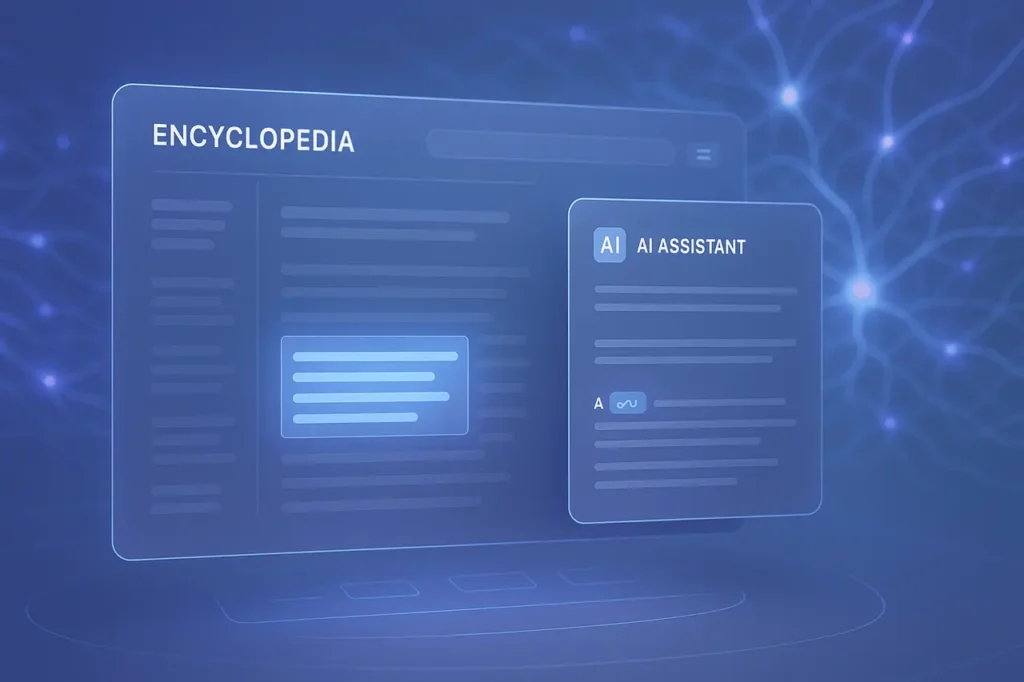
In the fall of 2025, a brand-new entry appeared in the online encyclopedia, Grokipedia. The site is advertised as an AI-powered alternative to Wikipedia. Grokipedia is built by xAI, which is the same company that developed Grok, the AI assistance system. By combining AI-generated content with the structure of a wiki, Grokipedia aims to offer an easily searchable, up-to-date collection of knowledge; however, its launch has sparked serious debate over the validity and bias of AI-generated content, as well as the future of AI-powered knowledge platforms.
This article will look at how Grokipedia works, why it’s essential, what experts say about it, and what to be aware of before using it as a source of information.
What Is Grokipedia?
Grokipedia is an online dictionary launched in October 2025. Contrary to traditional encyclopedias written by humans, Grokipedia’s primary content is created by Grok, a large language model developed by xAI.
When it first launched, the website was said to have between 800,000 and 885,000 pages. Some entries in Grokipedia use text from Wikipedia (or a close adaptation), whereas others develop entirely new content with the help of AI.
The interface resembles an online encyclopedia, with articles organised by topic, searchable entries, and sections similar to those readers would expect on Wikipedia.
Why Was Grokipedia Created?
The motivation behind Grokipedia stems from significant doubt about current knowledge-based platforms, especially regarding editorial control and bias. The advocates of Grokipedia, which include the top management at xAI, believe that AI could produce an even more “truth-oriented” Encyclopedia by utilising first-principles reasoning while minimising the perception of bias in the narrative.
Additionally, it capitalises on the growing need for faster, AI-aided access to information. With AI capable of processing vast quantities of data quickly, Grokipedia could, in theory, update faster than conventional Encyclopedias, providing real-time updates and the creation of entries, which are significant benefits in a world of constantly changing information.
How Grokipedia Works Behind the Scenes?
Content Generation
The majority of the content on Grokipedia is written through Grok’s language models. In some cases, models alter previously published Wikipedia content and sometimes change it under license. For new articles, Grok draws on a vast collection of datasets, including public archives and other sources.
This technique combines retrieval-based strategies (i.e., the AI collects relevant information) with the ability to generate (i.e., it can write coherent prose), effectively acting as a “wiki and AI” combination.
Review and Editing
When the service was first launched, the majority of entries could be fixed (locked); however, users could suggest edits or flag problems through a pop-up. There is evidence that some of these suggestions are evaluated by Grok itself in a semi-automated way rather than by editors, raising concerns about transparency.
Licensing
The entries that are directly derived from Wikipedia or modified versions are licensed under Creative Commons BY-SA 4.0. Other text created entirely by Grok utilises the “X Community License,” which permits reuse of the text under certain circumstances as defined by xAI.
What are the Promising Potential Advantages of Grokipedia?
- Scalability and Speed: AI-driven generation enables new subjects to be covered quickly without the need for volunteer editors. This capability could facilitate rapid expansion of content, allowing it to cover new subjects faster than traditional Encyclopedias.
- Unified Reasoning Process: Grokipedia aims to employ a unifying reasoning framework grounded in first principles that can help present subjects with clarity and structure.
- Accessibility and the Ease of Searching: The familiar layout of encyclopedias, coupled with AI-powered search and immediate content generation, could make learning and exploring complex topics much more on-the-fly.
- Potential for Current Contents: Because the system can theoretically insulate the most current information (depending on the configuration of its backend to work), Grokipedia might offer more recent content than static Encyclopedias.
What Critics Are Saying: Reliability, Bias & Transparency Concerns
Despite its advantages, Grokipedia has faced substantial criticism since its inception.
Doubts Over Accuracy and Source Quality
An analysis of research published just after the launch of Grokipedia revealed alarming patterns: the website relied on sources deemed by scholars to be “very poor trustworthiness” in terms of trustworthiness on multiple occasions. In a few instances, complete entries relied on questionable or extremist websites rather than on reliable academic or peer-reviewed sources.
These results raise serious doubts about its validity, particularly regarding controversial topics in politics and history, as well as other social issues.
Bias and Perspective Framing
Some critics argue that, despite its claim to neutrality, Grokipedia shows a right-leaning ideological orientation in the majority of its controversial entries. Because Grok is owned by an individual with a history of political affiliations and ties, it is possible that the AI’s view of “truth” could reflect biases and not be neutral research.
Lack of Transparent Editing and Oversight
In contrast to Wikipedia, which has changes monitored via public edit logs and volunteers who supervise the content, Grokipedia’s editing system is unclear. Users can suggest edits; however, there is no standard of review or guarantee for human moderators, and there is no clear evidence of changes. This is a detriment to one of the essential strengths of community-driven encyclopedias: accountability, which is enabled by open, collaborative collaboration.
Risk of Echo Chambers and Disinformation
Due to questionable sources and a possible bias towards the editorial, Grokipedia could spread false information or politically motivated narratives. For those seeking factual, reliable information, this is a significant negative.
What does this mean for Users?
For tech-savvy researchers, readers, and learners, Grokipedia is a fascinating new model: AI-powered, scalable, and potentially accelerating knowledge updates. However, the dangers posed by the source’s credibility, bias, and lack of transparency in editorials call for caution.
In the present, Grokipedia may be best seen as a complementary resource for entry into exploration, not as a definitive source. For serious research and scholarship, or for controversial issues, users must cross-check information with well-established sources, academic publications, or platforms vetted by community members.
The Broader Implication: AI and the Future of Knowledge
Grokipedia represents a new way to collect and use knowledge. As AI tools develop and evolve, the conventional model of community-created, human-written Encyclopedias may be challenged by artificial intelligence-driven, automated platforms.
However, this change also poses fundamental questions regarding authority, truth and the control of information: Who determines what constitutes reliable? How can we protect ourselves from bias when companies’ algorithms curate information? How do we maintain the integrity of our community and maintain trust in a world affected by AI?
Grokipedia does not yet offer definitive answers; however, it will force us to address these issues as the digital landscape of knowledge grows.
Final Thoughts
Grokipedia’s highlight-and-ask feature shows how AI can transform reading into a fun, personalised learning experience. The ability to immediately request more detailed explanations means users are not constrained by gaps in their background knowledge or the complexity of a subject. They can instead utilise Grok as a constant guide to clarify obscure terms, expand on subtle concepts, and help connect concepts across different disciplines.
As the broader debate about AI-generated information continues, encompassing questions of accuracy, authenticity, and transparency, this feature can be seen as a step in the right direction towards more user-friendly digital learning tools. As AI assistants integrate into information platforms, the future of learning will likely be more flexible, interactive, user-centric, and conversational.
Frequently Asked Questions
1. Do I consider Grokipedia as a reliable substitute for Wikipedia?
It’s not yet. Although Grokipedia provides a powerful artificial intelligence system, there remain issues regarding the source’s credibility, editorial transparency, and potential bias. If you are researching any controversial subject, it is advisable to confirm facts with established sources, such as peer-reviewed or community-reviewed sources.
2. How do you get Grokipedia to produce the content?
Most entries are written using Grok, an AI machine learning model trained on vast public databases and archives. Certain content is adapted from Wikipedia under license, and AI creates other entries.
3. Users can modify or add to Grokipedia, similar to Wikipedia?
It’s not exactly. At launch, users can’t directly edit the content. Instead, they may suggest corrections or flag issues using a form. Grok can evaluate these suggestions. There isn’t a public, transparent version history or a community moderation mechanism as in traditional wikis.
4. Does Grokipedia change faster than other online encyclopedias?
In the theory of things, in theory, it is. Since the AI can quickly create or edit information, Grokipedia has the potential to address new or changing topics faster than other volunteer-run platforms. But speed alone does not guarantee accuracy or dependability.
5. What types of subjects might be hazardous to put on Grokipedia?
Issues that are highly politicised, controversial social or historical issues, or any topic characterised by strong ideological or cultural gaps are at risk of being targets of criticism. The articles on these topics could be biased, rely on questionable sources, or ignore significant contextual information.
6. Do I need to utilise Grokipedia to do my academic or professional work?
It is not recommended to rely solely on Grokipedia for serious research in academic or professional fields. Instead, use it as an initial exploratory tool, then verify the facts using peer-reviewed papers, reputable publications, and traditional encyclopaedias.
Also Read –
Grokipedia Android Installation Guide: How to Install the AI Encyclopedia App on Your Phone (2025)
Why Grokipedia is So Important in the Age of Misinformation
Grokipedia Launch: AI-Powered Open-Source Encyclopedia Debuts