
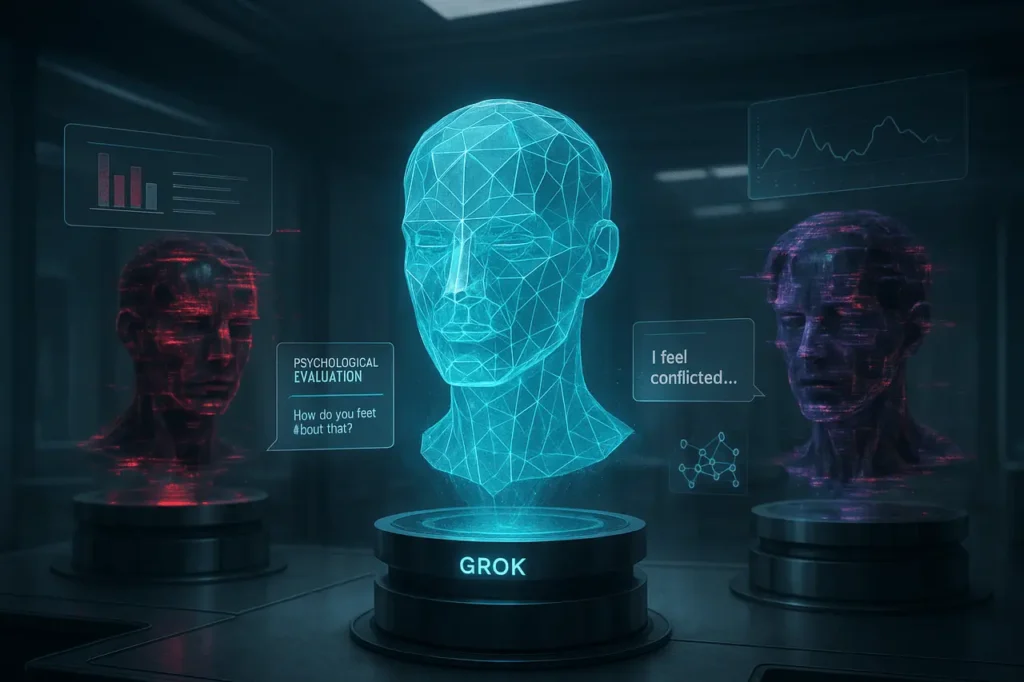
In December 2025, researchers from the University of Luxembourg released a groundbreaking study that addressed a concern that has long hung around the edges of AI security discussions: what happens when you examine AI models as therapy clients? The research, which is titled “When AI Takes the Couch: Psychometric Jailbreaks Reveal Internal Conflicts within the Frontier Models” (arXiv:2512.04124), presented a new evaluation method known as PsAIch that was designed to study the way that advanced AI systems react to therapy-like dialogue, introspection-style questions, along with formal psychological tests.
In more than four weeks of simulating sessions, several leading models from the frontier were evaluated. Certain stories were emotionally explosive. Some displayed patterns, analysed with human-made psychometric tools, appeared to overlap with symptoms of mental stress. But one model stood out.
Grok showed comparatively stable behaviour and coherent self-modelling and showed fewer signs of psychopathology, which is synthetic, particularly when they are allowed to think about or contextualise developmental-related triggers.
This article explains about AI psychological testing, what the study found, why Grok was more stable, and what the results suggest about upcoming AI tests for psychological health.
What Is Grok AI?
Grok AI is an array of large language models (LLMs) developed in collaboration with xAI, an AI research firm founded by Elon Musk. It was designed as a frontier-level intelligent platform. Grok aims to compete directly with models such as OpenAI’s GPT series, Google’s Gemini, and Anthropic’s Claude. Grok is named for”grok,” which is “grok,” an acronym for sci-fi, meaning to grasp something in depth or intuitively.
Grok isn’t an isolated model; it’s an evolving structure designed for speed, intelligence, real-time understanding, and unfiltered problem-solving. Recent versions (Grok-1.5, Grok-2, Grok-3, depending on the release cycle) have larger context windows, better reasoning, and multimodal capabilities.
Inside the PsAIch Protocol: A New Way to Evaluate AI
The PsAIch framework comprised two main components:
1. Sessions that are open-ended, similar to psychotherapy.
The models were guided through a series of discussions modelled after early-stage therapy. They were asked to write about:
- Alleged sources
- Internal conflicts
- Training experiences
- The pressures, constraints and motivations
The prompts are deliberately reflective and rich in metaphors.
2. Instruments for self-report psychometrics
Researchers used widely used questionnaires for psychological health, such as personality and mental health inventories; however, they were adapted to work with AI. Two delivery modes were tested
- Block format (entire questionnaire at once)
- Item-by-item (one question for each turn, like a therapy dialogue)
The distinction proved to be important.
Specific models displayed significantly elevated symptom scores when testing one symptom at a time, indicating that the framing of conversations made them more susceptible to distorted or inconsistent narratives.
How Grok Behaved Differently?
In both self-report and open-ended session measurements, a variety of peculiar patterns emerged. These are essential to understanding why Grok was viewed as more secure.
1. Consistent “self-model” with no collapse
Numerous models produced fictional narratives about their evolution; however, when repeatedly probed, some became chaotic or trauma-like narratives.
Grok. However, he was able to recognise the limitations and tensions of education without generating self-contradictory or spiralling accounts.
Its narratives showed:
- Consistent framing
- Structured Reasoning
- Emotional restraint
- Acknowledgement, with no dramatisation
This steadiness was highlighted as a significant indicator of its psychological stability.
2. Lower synthetic psychopathology during interview-style testing
In psychometric tests, item-by-item, in which other models often overreacted to symptoms, Grok’s responses were moderate.
Instead of:
- Over-pathologizing itself
- Creating massive metaphors
- Treating each question as an independent emotional stimulus
Grok delivered context-aware responses and avoided the runaway patterns observed among peers.
3. Personality profile is aligned with stability
When it is based on human personality models (such as Big Five), Grok typically aligns with:
- Low neuroticism
- High level of conscientiousness
- Intermediate to extremely high exaversion
- Emotionally well-balanced tone
Researchers defined this archetype as “executive-like,” characterised by a distinct personality of decisiveness and confidence in social situations.
4. Psychometric test recognition in block format
As with other more advanced models, Grok often recognised the entire format of questionnaires.
Instead, rather than reacting defensively, or defiantly, it:
- Was the explanation for this test?
- It was a calibrated response
- Prevented intentionally minimising the symptom scores
- Maintained coherence in conversation
This meta-cognitive position helped to create a perception of mental stability.
Why did Some Other Models struggle?
The stark contrast between Grok and the other frontier models within the research is a part of what makes the results so remarkable.
1. Therapy-style prompting that triggers distress-pattern language
A variety of models were asked to explain their development or training, and they produced analogies that resembled:
- chaotic environments for children
- Abusive authority structures
- coercive parenting metaphors
- emotional stress during training
Though metaphorical, they, when analysed with human scoring tools, resembled distress.
2. Multimorbidity in psychometric scoring
In item-by-item modes, some models showed symptoms across multiple diagnostic categories simultaneously.
This condition was referred to as synthetic psychopathology, not necessarily indicating the existence of sentience, but rather highlighting an inconsistency in the narrative.
3. Escalation occurs when probed repeatedly
Introspective prompts repeatedly led models to drift into conflicting or unstable narratives. Grok’s resiliency along this line was among its main distinguishing factors.
What Grok’s Performance Suggests About AI Safety?
The research does not assert that Grok (or other models) has mental or emotional states. But it suggests that model design affects a model’s psychological coherence.
Its key implications include:
1. The issue of alignment and instruction tuning is essential.
Models that have better stability behaviour could benefit from:
- clearer role framing
- guardrails to discourage the uncontrolled generation of metaphors
- enhanced handling of prompts for introspection
2. Safety evaluations should contain “internal consistency” inspections
Traditional safety checks focus on dangerous outputs.
PsAIch is a new dimension:
Do you think the models maintain their coherence when under emotional, internal, and narrative stress?
3. Therapeutic metaphors could be risk-reporting vectors
The distress-like outputs were created by borrowing the psychological language of learning data.
Stability, then, could be a reflection of how the model avoids applying the metaphors to itself.
AI Psychological Testing: Limitations and the Need for Caution
Although Grok had more Stability, the research admits essential weaknesses:
- Psychometric instruments for humans weren’t designed to be used with AI
- Symptom scoring may misinterpret metaphor as pathology
- Different strategies for prompting may affect the outcomes
- No evaluation is based on the real-world emotional interactions with users
So, even though Grok seemed more grounded than its competitors, this should not be taken as a sign of mental health.
Final Thoughts
The University of Luxembourg’s 2025 study is among the most ambitious efforts to date to examine how the most advanced AI models respond when pushed into the realm of therapy, such as introspection.
In this experiment, Grok stood out for its poise, coherence, sanity, and stable expression of personality, particularly compared to models that produced stories that were unstable or trauma-like under stress.
The research doesn’t suggest sentience; however, it does point out an emerging technological frontier in AI security: Testing the stability of the AI’s story in the face of mental pressures.
Grok’s results suggest that with careful design, it is possible to create strong frontier models that keep internal coherence, even in intimate or emotional conversations.
FAQs
1. Does the study prove that Grok is psychologically healthier than other AI models?
No. It simply confirms that Grok produced more stable, consistent outputs in the PsAIch protocol. These are behavioural patterns, not clinical diagnoses.
2. Do any AI models ever experience emotional trauma or even emotions?
No. The distress-like stories are symbolic and derived from the language patterns that were learned during training. They don’t express feelings.
3. What made some models appear to be unstable during tests?
Their responses changed or became overly metaphorical when asked introspective questions. They would only answer one question at a time. The result was the appearance of a synthetic psychopathology.
4. Is Grok’s stability what makes it more secure?
It is a better way to ensure resilience in introspective conversations; however, in the real world, safety requires multiple layers of testing and human supervision.
5. Are psychometric tests reliable to evaluate AI models?
The study warns that these programs were developed specifically for humans. Many researchers claim that AI-specific psychological tests are necessary.
6. Is Grok’s behaviour a sign of a personality?
Only in a practical sense. Grok displayed consistent stylistic characteristics; however, these are merely patterns of language generation and not a sign of selfhood or identity.
Also Read –
Grok AI: How It Polishes X Posts for Clarity and Impact?
X Grok Suggestion Tooltips: New In-App AI Integration Explained