
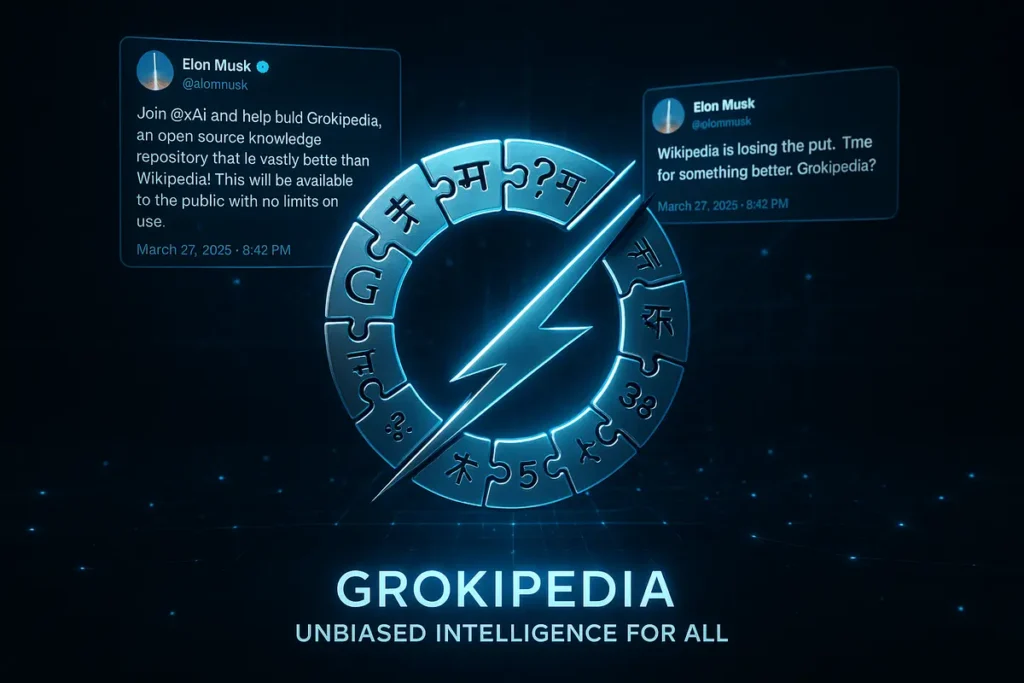
In a world filled with information, and misinformation, the need for a transparent and trustworthy resource platform is never more crucial. Enter Grokipedia, an innovative initiative based on the following guidelines (as stated in a tweet recently):
- Open access, no restrictions, absolutely free for everyone
- Unaffected by activist or political manipulation
- Created to remove any bias or agenda-driven edits
- Open-source knowledge repository
Grokipedia isn’t merely another knowledge base. It’s a campaign to bring back trust, transparency and rigour on the internet. Its goal is to make the truth accessible and available to everyone. The concept comes in a moment where online encyclopedias, AI-driven knowledge systems, and user-generated content are being scrutinised in the wake of allegations about bias, manipulation and even agenda. As the AI technology advances, it is now a matter of who owns knowledge, how it can be confirmed, and how a platform is designed to be resistant to the effects of distortion.
What exactly is Grokipedia?
Grokipedia is a proposed online platform for knowledge that was created by xAI (founded by Elon Musk) that aims to become a new generation online encyclopedia that is free, open and designed to be useful to both machines and humans.
As per Musk, “We are building Grokipedia xAI. This will be a huge advancement over Wikipedia. It is, in fact, an important step toward an xAI goal of comprehending how to understand the Universe.”
While the details are restricted, the media reports indicate that Grokipedia will make use of AI technology (from an AI-powered “Grok” chatbot platform) in conjunction with community editing as well as open source protocols.
In simple terms, it is an encyclopedia based on collaboration via wikis and AI-powered verification and open data and source code.
The Key Concepts and Principles behind Grokipedia
The Tweet and its announcements reveal the core foundations behind Grokipedia, summarised in the Key Principles of Grokipedia an AI Encyclopedia.
- Unrestricted Access – Grokipedia will be totally free, offering no subscription fees, no paywalls or restrictions on reading. The tweet emphasises “completely accessible to everyone”. This is in keeping with the initial web ethos of sharing knowledge.
- Immune to political or activist manipulation – The most significant criticisms lobbed by Musk and others against existing Encyclopedias (notably the Wikimedia Foundation’s Wikipedia) are that their editorial systems are susceptible to being snatched by ideologies. Grokipedia is attempting to shield it from agenda-driven changes.
- Built to Eliminate Bias and Agenda-Driven Edits – Although bias can’t be eliminated, however, the platform will create structures (editor logs, versions and transparent sourcing AI tools) to reduce influence and expose the assumptions that underlie the user.
- Fully Open Source Knowledge Repository – The backend code, such as APIs, data models, as well as edit logs, has been planned to be auditable and open, which will allow transparency and community control. This means it is possible to ensure that the repository is susceptible to examination.
Together, the four ideals correspond exactly to the message of the tweet; however, the real challenge lies in how they’re implemented in the real world.
The Vision Behind Grokipedia
The larger goal of Grokipedia is connected to xAI’s goal of building machines that “understand all of the world” (in Musk’s phrase). Through the creation of a fundamental “truth layer” -an open, authentic repository of information, xAI claims that machines and humans can think more efficiently.
In that sense, Grokipedia is more than an encyclopedia. It’s infrastructure. It’s a public benefit. A knowledge-based commons that was created in the time of AI.
Historically, the promise of the internet to provide the ability to access all information was held back by fragmentation, paywalls, misinformation and bias. Grokipedia comes into this scenario as an alternative to correcting this issue — a new-generation platform that addresses a variety of criticisms of the previous knowledge-based technology.
For instance, Wikipedia has been accused of having biases in its system (gender and ideological, as well as geographic). Researchers point out that the editors on volunteer sites tend to be predominantly male and come from certain cultural backgrounds, which limits the diversity of opinions.
Grokipedia’s mission is to reverse these defaults through design and introduce algorithmic verification, open code, and edits that are open edits, with a particular focus on bias-reduction.
Reason: Why Internet require Grokipedia?
The web and its users are confronted with multiple pressures, which make a project such as Grokipedia appropriate:
- Information and misinformation: The rapid dissemination of half-truths, fabricated claims, and fake references means that having a reliable “ground truth” is becoming more important.
- Bias in Existing Systems: Large knowledge repository sites (including Wikipedia) have been in dispute based on bias as well as editorial capture in the absence of full transparency.
- AI Knowledge Dependencies: Large Language Models (LLMs) usually use data scraped from websites like Wikipedia. If the training data is contaminated by bias, it can be propagated to AI outputs. Grokipedia strives to be an improved knowledge base for both machine and human users.
- Digital Trust Deficit: online users are increasingly questioning the legitimacy of data. A platform that publishes openly edited history, versioning audits, and open-source software could assist in restoring trust.
- Education and Global Access: The notion of “knowledge for everyone” is still a dream across the world. An accessible, free, multilingual, open-source Encyclopedia can bridge the gap.
Shortly: Grokipedia may help address the fundamental problem of who decides what people are told they are by transferring some of the power into the public domain.
Grokipedia vs Wikipedia
| Feature | Grokipedia | Wikipedia |
|---|---|---|
| Founder/Developer | Elon Musk’s xAI | Wikimedia Foundation |
| Content Creation | AI-assisted + human oversight | Human volunteers only |
| Bias Handling | Maps multiple viewpoints transparently | Enforces neutral point of view |
| Updates | Real-time / dynamic updates | Slower, manual updates |
| Source Transparency | Every claim linked with metadata | Citation required, but less structured |
| Access | Free, open access | Free, open access |
| Auditability | Full version history with AI/human attribution | Version history for human edits only |
| Focus | Truth verification, AI intelligence, open knowledge | Collaborative, crowd-sourced encyclopedia |
Grokipedia makes use of AI for speedier, clearer and richer viewpoints; in contrast, Wikipedia depends on humans to edit as well as consensus-based neutrality. Grokipedia is aiming to become an online encyclopedia with the latest technology, emphasising transparency, accuracy and continuous updates.
Potential Use Cases and the Future Implications
Below are a few concrete ways Grokipedia could play out and what the implications for the future could be:
- For Researchers & Students: Instead of relying only on traditional encyclopedias and paid-for journals, users can access a free, updated, current, and audited knowledge repository.
- For Developers & AI Systems: Open APIs may allow AI chatbots or educational platforms, and search engines to draw information from Grokipedia as a reliable source, thereby increasing the accuracy of knowledge overall.
- For Journalists and Fact-checkers: Version history editing metadata, as well as source tracking, can simplify the verification process and lessen the stress of discovery.
- Global Reach and Multilingual Expansion: If it is done correctly, Grokipedia might extend to areas and languages that are not served and help promote knowledge equity.
- Effects upon Search, Discovery & Education: An “truth-layer” repository could alter the way that search engines rank the content they index, how teachers take on open knowledge, and how they integrate authentic content in real-time.
If it is successful, Grokipedia could usher in a new age that is a new era of “commons knowledge” which acts as an infrastructure for civil society as well as machine intelligence.
Opportunities and Challenges
Any revolutionary initiative is without challenges:
- Editorial and Governance Complexity: Access for free and open editing can lead to the spread of spam, vandalism and ideological conflict. To ensure neutrality, you need robust security systems.
- The bias of AI & Data Sources: Despite the goal to eliminate bias, Grokipedia is still dependent on models, datasets and editors who are human -each of which has implicit biases. Researchers have warned that AI is at risk of creating or increasing bias.
- Participant Diversity: Making sure that editors have different cultures, geographic regions, and languages is essential for the creation of a balanced view — this is a constant problem for crowdsourced knowledge platforms.
- Business/Economic Model and incentives: The service is free to users, the operation of this platform (compute costs such as moderation, infrastructure, etc.) might require a revenue source and, in turn, provide incentives that go against neutrality.
- Adoption and Trust: Although it is technically sound, convincing society and the institutions to believe and embrace Grokipedia could be especially considering the history of trust that Wikipedia has built up.
However, many opportunities are changing the way that information is verified and the way AI interacts with human expertise and how an open infrastructure could transform this digital landscape.
Final Thougths
Grokipedia is in the middle of artificial intelligence, open-source knowledge, and digital trust. Its mission is to make “truth inaccessible to everyone.” It sets the bar high. Grokipedia may not just replace existing encyclopedias that exist, but it could even redefine them to meet the needs of future use in the AI age. If it is designed with care and with transparent governance, multiple sources of information, a rigorous process for verification, and open-source roots, Grokipedia could end up being a fundamental element of the internet’s knowledge infrastructure. The world is wrestling with the issue of what is true, what to believe, where to go to find the truth and how to ensure knowledge is available to all. Grokipedia could have come just at the right time.
Frequently Asked Questions (FAQs)
What’s Grokipedia?
Grokipedia is an open-source knowledge repository that is free and created through xAI (founded by Elon Musk), intended to be an encyclopedia of the future that is free of bias, with open access, and AI-powered verification.
Who’s responsible for Grokipedia?
The project is helmed by xAI, an artificial intelligence startup founded by Elon Musk. Musk made a public announcement of the project on X, his X channel, that Grokipedia would be “a huge advancement in comparison to Wikipedia.”
What makes Grokipedia differs from Wikipedia?
Although Wikipedia is free and edited by the community but critics say that it is plagued by editor bias and ideological capturing. Grokipedia strives to be more by:
- Fully open source, both in terms of code and data
- Making use of AI tools to verify and detect bias detection
- Transparent edit logs for publishing as well as versioning metadata, and audit trails
- Unrestricted access to everyone
What is the likelihood that Grokipedia will be available for free?
Yes. One of the pillars Grokipedia has stated is “unrestricted open access, and completely free for anyone.” The announcements made public highlight a zero-paywall system.
What time will Grokipedia start?
According to a press publication, Elon Musk stated that version 0.1 of Grokipedia’s beta version will be available in the next two weeks (in the early part of October in 2025).
What challenges does Grokipedia confront?
The main challenges are the need to ensure neutrality and avoid new biases, as well as managing the openness of editing, guaranteeing an efficient infrastructure model that can last and drawing a diverse community of contributors and gaining public trust.
What should I know concerning Grokipedia?
Because knowledge is the foundation of everything, including education, policies, AI, and culture, a reliable, open, free platform that is verified can affect how we learn, the way machines reason, as well as how societies debate. Grokipedia could be an essential element for the next generation of AI and knowledge systems.
Sources
- Musk’s tweet announcing Grokipedia:
- Announcement of early beta version by xAI: “version 0.1 early beta”, etc.
- Commentary on bias in Wikipedia and the challenge Grokipedia addresses.
- Wikipedia entry on xAI and Grokipedia (structure of the project).