
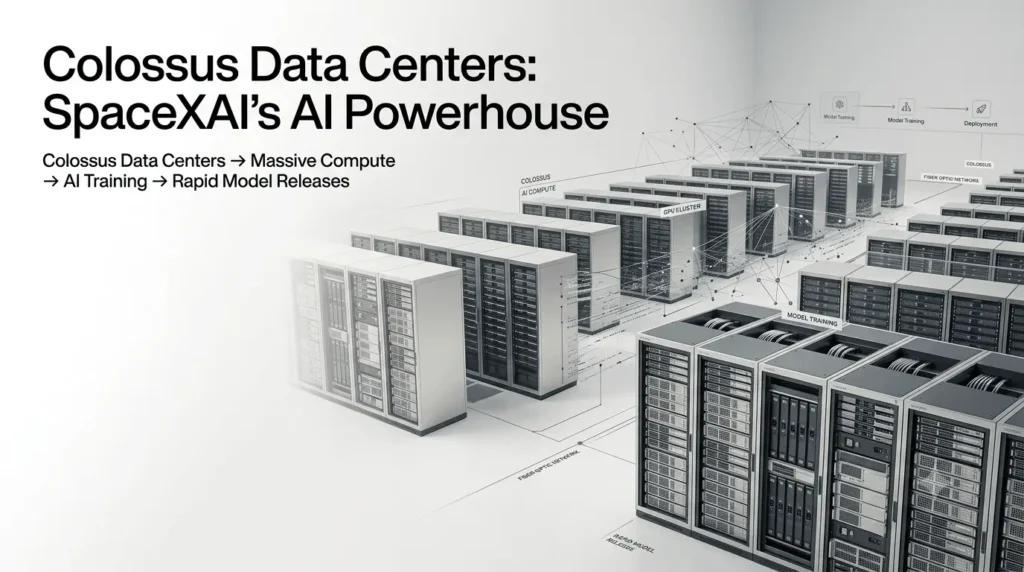
SpaceXAI’s rapid AI model releases are closely tied to one of its biggest infrastructure advantages: Colossus, its large-scale AI supercomputing infrastructure in the Memphis area. Built to train and run frontier AI systems, Colossus gives SpaceXAI direct access to massive amounts of compute instead of relying entirely on external cloud providers.
That matters because frontier AI development is increasingly constrained by computing capacity. Training a new model, running reinforcement learning, generating synthetic data, evaluating different versions, and serving millions of users all require enormous amounts of GPU capacity.
SpaceXAI says the original Colossus system was built in 122 days and then doubled to 200,000 GPUs in another 92 days. The company has also outlined a roadmap toward 1 million GPUs.
The result is an infrastructure strategy designed around one objective: move from AI research to large-scale training and deployment as quickly as possible.
What Are the Colossus Data Centers?
The Colossus data centers are SpaceXAI’s large-scale AI computing facilities in the Memphis, Tennessee area, built to provide the computational infrastructure required for training and operating models such as Grok.
The name Colossus is often used to describe the overall AI supercomputer rather than a conventional single data center. SpaceXAI describes Colossus as its “gigafactory of compute,” with tightly interconnected GPUs designed for large-scale distributed AI workloads.
The infrastructure is particularly important because modern AI models cannot be trained efficiently by treating thousands of GPUs as independent computers. They need high-speed communication between accelerators, large amounts of memory bandwidth, fast networking, and storage capable of handling enormous training datasets and model checkpoints.
SpaceXAI’s published Colossus figures include:
| Infrastructure | SpaceXAI-published figure |
|---|---|
| GPUs | 200,000 H100 GPUs |
| Build time | 122 days |
| Time to double capacity | 92 days |
| Aggregate memory bandwidth | 170 PB/s |
| Per-server network bandwidth | 2.8 Tb/s |
| Training storage | More than 0.5 EB |
| Long-term roadmap | Up to 1 million GPUs |
These figures describe the company’s published Colossus infrastructure and should not be confused with independent estimates for newer expansion projects.
Why Does Colossus Matter for AI Model Releases?
The biggest advantage of Colossus is not simply having a large number of GPUs. It is the ability to control a large portion of the AI development infrastructure directly.
A frontier model can require repeated cycles of:
- Pretraining
- Evaluation
- Fine-tuning
- Reinforcement learning
- Safety testing
- Inference testing
- Optimization
- Deployment
- Post-release iteration
Every cycle consumes compute.
If researchers have to wait for external infrastructure to become available, experimentation can slow down. With a large dedicated cluster, more of these workloads can be scheduled internally.
That creates a shorter feedback loop between researchers and infrastructure.
Compute Becomes a Product Development Advantage
For an AI company, GPUs are not simply hardware sitting in a warehouse. They are part of the product development pipeline.
More available compute can allow teams to:
- Run larger training experiments
- Test more model configurations
- Increase reinforcement-learning workloads
- Generate synthetic training data
- Evaluate multiple checkpoints
- Run extensive benchmark tests
- Support large-scale inference
- Deploy new capabilities without immediately exhausting capacity
This does not automatically mean that more GPUs produce a better model. Architecture, data quality, training methods, algorithms and research talent still matter.
But sufficient compute can remove one major bottleneck.
How Fast Was the Original Colossus Built?
Colossus became notable because of the speed at which SpaceXAI built it.
SpaceXAI says the original system became operational in 122 days, compared with the much longer timelines traditionally associated with building major AI infrastructure. The company also says it began running workloads only 19 days after the first servers were delivered.
The infrastructure was built by repurposing an existing industrial facility rather than starting with a completely new greenfield campus.
That approach is important.
A conventional hyperscale data-center project can involve lengthy processes around land, construction, electrical infrastructure, cooling, networking and equipment deployment. SpaceXAI’s strategy emphasized moving quickly by taking control of as many parts of the process as possible.
The company later doubled the system to approximately 200,000 NVIDIA Hopper GPUs.
Colossus 1 vs. Colossus 2
The term “Colossus” has increasingly become associated with an expanding network of AI infrastructure rather than one static computer.
SpaceXAI’s original Colossus reached the 200,000-GPU scale. Additional facilities and expansion projects in the Memphis and Southaven area are designed to increase the overall compute footprint.
Publicly available third-party research provides estimates for Colossus 2 that go beyond SpaceXAI’s published specifications. Those estimates should be treated separately from official figures.
For example, Epoch AI’s September 2026 data-center analysis estimates that Colossus 2 is operational and has more than 1 million H100-equivalent compute capacity, while also estimating its power and capital requirements. Those are independent estimates, not SpaceXAI’s official specifications.
That distinction is important when discussing the current size of SpaceXAI’s infrastructure.
Why Colossus 2 Matters?
The expansion matters because frontier model development increasingly requires compute at multiple stages.
A larger infrastructure footprint can potentially support:
- New model training runs
- Reinforcement learning
- Agent training
- Multimodal model development
- Image and video generation
- Large-scale inference
- Enterprise workloads
- Experimental research
SpaceXAI has also signed an agreement with Anthropic to provide access to Colossus 1. The company said in May 2026 that Colossus 1 had more than 220,000 NVIDIA GPUs across H100, H200 and next-generation GB200 accelerators.
The difference between these figures and older descriptions of the cluster illustrates why GPU counts can become confusing: infrastructure is continually being expanded, upgraded and described at different points in time.
How Colossus Helps SpaceXAI Train Grok?
One of the clearest examples of Colossus’s role is Grok 4.
When SpaceXAI introduced Grok 4 in July 2025, it explained that Colossus was used for reinforcement-learning training at pretraining scale. The company said the 200,000-GPU cluster allowed it to scale reinforcement learning substantially as it worked on improving Grok’s reasoning capabilities.
This is significant because modern frontier-model training is no longer limited to traditional next-token prediction.
Reinforcement learning can require large numbers of training and evaluation cycles. Researchers need to generate trajectories, score them, update models, repeat experiments and evaluate whether the new behavior actually improves performance.
A massive cluster makes these iterative workloads much more practical.
From Pretraining to Reinforcement Learning
A simplified Grok development pipeline can look like this:
Large-scale compute → pretraining → evaluation → supervised fine-tuning → reinforcement learning → safety testing → deployment → additional training
Colossus can support multiple parts of this pipeline.
The key advantage is not necessarily that everything happens simultaneously. It is that SpaceXAI has a large pool of infrastructure that can be allocated according to the development stage.
Why GPU Networking Matters as Much as GPU Count?
It is easy to look at a figure such as “200,000 GPUs” and assume that the number alone explains Colossus’s performance.
It doesn’t.
Large AI training jobs depend heavily on how quickly GPUs can communicate with one another.
During distributed training, different accelerators continuously exchange information. Slow communication can leave expensive GPUs waiting instead of computing.
SpaceXAI says Colossus uses NVIDIA Spectrum-X Ethernet networking and reports 2.8 Tb/s of per-server network bandwidth and 170 PB/s of aggregate memory bandwidth across the system.
This infrastructure is what turns thousands of individual accelerators into something closer to a single large computational system.
In practical terms, the goal is to keep GPUs busy rather than allowing communication, storage or networking to become the limiting factor.
How Fast Infrastructure Can Lead to Faster Model Releases?
Colossus does not literally “release” AI models. Researchers, engineers and product teams do that.
Its role is to shorten the computational part of the development cycle.
Consider a simplified example.
Suppose researchers have five different training strategies they want to test.
With limited compute, they may have to run them sequentially:
Experiment A → Experiment B → Experiment C → Experiment D → Experiment E
With substantially more infrastructure, some experiments can run in parallel:
A + B + C + D + E
That does not guarantee a five-times-faster development process. Dataset preparation, software engineering, evaluations, human review and other bottlenecks remain.
But reducing compute-related waiting time can dramatically improve research iteration.
This is one reason AI infrastructure has become a strategic advantage rather than merely an operational expense.
Colossus and SpaceXAI’s Rapid 2026 Releases
The relationship between compute infrastructure and product releases is particularly visible in SpaceXAI’s 2026 release schedule.
After SpaceX acquired xAI in February 2026, the combined company continued expanding the Grok ecosystem.
Recent releases include:
- Grok 4.6 — introduced August 12, 2026, with a focus on long-running agents, coding, knowledge work and interactive applications.
- Grok Bot — introduced in beta on August 11, 2026, as an always-on agent capable of working across tools and applications.
- Imagine Image 2.0 — released August 7, 2026, for advanced image generation and editing.
- Grok 4.6 integrations — expanded to platforms including GitHub Copilot, Amazon Bedrock, Microsoft Foundry and Google’s Gemini Enterprise Agent Platform during August 2026.
These products are not all trained exclusively on Colossus, and SpaceXAI does not publicly attribute every release to a particular cluster.
The more defensible conclusion is that large-scale compute gives SpaceXAI the infrastructure capacity needed to pursue several AI product tracks simultaneously.
Does More Compute Automatically Mean Faster AI Progress?
No.
This is one of the most important misconceptions surrounding Colossus.
A larger data center does not automatically produce better AI.
Model quality also depends on:
- Training data
- Data filtering
- Model architecture
- Optimization techniques
- Reinforcement-learning design
- Evaluation methodology
- Software infrastructure
- Research talent
- Safety systems
- Inference optimization
Compute is an enabler.
The advantage comes when a company combines large-scale compute with an effective research and engineering process.
SpaceXAI itself describes its development philosophy around first-principles reasoning, rapid iteration and solving infrastructure problems directly.
Why SpaceXAI Is Building So Much Compute
SpaceXAI’s long-term strategy goes beyond supporting a single Grok model.
The company has described a roadmap toward 1 million GPUs for its Memphis infrastructure.
That scale would support a broader AI platform involving:
- Frontier language models
- Reasoning systems
- AI agents
- Image generation
- Video generation
- Voice systems
- Enterprise AI
- Large-scale inference
- Future research workloads
The more AI capabilities SpaceXAI develops, the more important compute capacity becomes.
A company that controls substantial infrastructure can also make longer-term decisions about hardware, networking, power, cooling and deployment instead of treating compute as a completely external resource.
The Power Challenge Behind Colossus
There is another side to building enormous AI data centers: electricity.
Training and operating large AI systems requires substantial power, and quickly expanding a data center can be difficult if the surrounding electrical infrastructure cannot supply enough capacity.
SpaceXAI has therefore pursued dedicated power infrastructure around its Memphis-area facilities.
In July 2026, the company said it had entered an agreement with the Mississippi Department of Environmental Quality establishing a timeline to remove 69 temporary mobile turbines in Southaven as permanent power from a 1.2-GW power plant is brought online.
The energy strategy has attracted scrutiny.
Reuters reported in June 2026 that AI companies across the United States were increasingly pursuing dedicated or off-grid natural-gas power projects to accelerate data-center deployment, highlighting concerns around environmental impact and regulatory oversight.
For SpaceXAI, this illustrates a fundamental reality of frontier AI infrastructure:
Building enough GPUs is only half the problem. You also need enough electricity, cooling, networking and physical space to operate them.
Why Building Near Memphis Matters?
Memphis offers SpaceXAI an unusual combination of industrial space and access to major power infrastructure.
The company converted a roughly 1-million-square-foot former industrial facility into a technology and AI infrastructure site.
Repurposing existing industrial buildings can potentially accelerate deployment compared with constructing an entirely new facility from scratch.
The broader Memphis-area strategy also allows SpaceXAI to build a larger infrastructure footprint across multiple sites.
That geographic expansion is important because frontier AI infrastructure is becoming more like an industrial operation than a conventional software deployment.
Colossus vs. Traditional Cloud AI Infrastructure
The biggest difference between Colossus and a typical cloud AI workflow is control.
| Area | Dedicated Colossus Infrastructure | Conventional Cloud Approach |
|---|---|---|
| Compute ownership | Direct control | Usually rented |
| Capacity planning | Internal | Provider-dependent |
| Hardware deployment | Customized for workloads | Provider-defined |
| Networking | Designed for large AI clusters | Shared/cloud architecture |
| Power strategy | Dedicated infrastructure | Cloud provider manages it |
| Scaling | Physical expansion required | Often easier to provision |
| Infrastructure flexibility | High internal control | High service-level flexibility |
| Main advantage | Control and scale | Convenience and broad availability |
Neither approach is universally better.
Cloud infrastructure remains extremely useful for startups, developers and organizations that need flexible access to GPUs without building data centers.
For a frontier AI company training extremely large models, however, owning or directly controlling enormous compute infrastructure can provide a different kind of advantage.
Colossus and the Economics of Frontier AI
AI data centers are extraordinarily expensive.
The economics involve much more than purchasing GPUs.
A frontier AI infrastructure project may require:
- Accelerators
- Networking equipment
- Servers
- Storage
- Cooling systems
- Transformers
- Electrical distribution
- Power generation
- Buildings
- Fiber connectivity
- Operations teams
- Hardware maintenance
- Software infrastructure
The initial capital cost is only part of the equation.
Electricity and hardware utilization become ongoing concerns.
This creates a fundamental tradeoff.
If a company has too little compute, researchers may be constrained.
If it builds enormous capacity but cannot keep that capacity sufficiently utilized, the economics become harder.
SpaceXAI’s strategy is therefore based on the assumption that continued growth in AI demand will justify extremely large-scale infrastructure.
Does Colossus Power Every SpaceXAI Model?
Not necessarily.
It is important not to interpret “Colossus powers Grok” as meaning every model, every experiment and every inference request runs on one specific cluster.
SpaceXAI has multiple infrastructure locations and external partnerships.
For example, Grok 4.6 is now available through services including Amazon Bedrock, Microsoft Foundry and Gemini Enterprise Agent Platform.
SpaceXAI has also announced an agreement giving Anthropic access to Colossus 1.
That means Colossus is better understood as a major part of SpaceXAI’s overall compute strategy rather than the exclusive physical location for every AI workload.
What Is the 1 Million GPU Roadmap?
SpaceXAI has repeatedly described a long-term goal of scaling its Memphis-area infrastructure toward 1 million GPUs.
However, readers should be careful with the wording.
A roadmap is not the same thing as a currently deployed GPU count.
SpaceXAI’s official Colossus page currently highlights the 200,000-GPU configuration, while its Memphis site describes the longer-term 1-million-GPU ambition.
Independent data-center researchers may publish different estimates based on satellite imagery, power usage and equipment observations. Those estimates can be useful, but they should not be presented as official SpaceXAI specifications.
What Could Colossus Mean for Future AI Models?
If SpaceXAI continues expanding compute capacity, the impact could extend beyond simply making larger language models.
More infrastructure could support increasingly complex training approaches involving:
- Longer reinforcement-learning runs
- More sophisticated AI agents
- Multimodal training
- Image and video generation
- Synthetic data generation
- Scientific computing
- Large-scale model evaluation
- Continuous model improvement
The company’s recent product direction already points toward a broader AI ecosystem rather than a single chatbot.
Grok 4.6 focuses heavily on agents and technical work, while Imagine Image 2.0 expands the generative-media side of the platform.
Colossus provides the physical compute foundation underneath that expansion.
What Are the Limitations of the Colossus Strategy?
Building huge AI data centers also creates major challenges.
Energy requirements
Large GPU clusters require enormous amounts of electricity. Expanding power generation quickly can create environmental and regulatory concerns.
Hardware availability
Building at extreme scale depends on access to advanced accelerators, networking equipment and other specialized components.
Cooling
High-density AI servers generate significant heat and require sophisticated cooling infrastructure.
Capital intensity
The cost of building, powering and maintaining large AI clusters can reach extraordinary levels.
Utilization
Expensive GPUs need to remain productive enough to justify their cost.
Regulatory pressure
Large data centers can affect local power systems, air quality, water resources, land use and surrounding communities.
These constraints mean that infrastructure scale alone is not a guaranteed competitive advantage.
Colossus Data Centers: Why They Matter?
The most important takeaway is that Colossus is not simply a large warehouse full of GPUs.
It represents a vertically integrated approach to frontier AI infrastructure.
SpaceXAI has tried to shorten the distance between:
AI research → compute → training → evaluation → deployment → product
The original Colossus was built in 122 days, expanded to 200,000 GPUs, and became a critical resource for training systems such as Grok 4.
At the same time, the company is pursuing much larger infrastructure and power capacity.
That strategy helps explain how SpaceXAI can work on multiple AI products and model generations at a rapid pace. It does not eliminate every bottleneck, but it gives the company control over one of the most important constraints in modern AI development: compute.
As frontier models become more expensive to train and increasingly agentic, the companies that can secure massive amounts of compute, power and networking infrastructure may have an important advantage.
Conclusion
Colossus Data Centers give SpaceXAI direct access to one of the most important resources in frontier AI: massive computing capacity.
The original system reached 200,000 GPUs after being built and expanded at unusual speed, while the company continues to pursue a much larger 1-million-GPU roadmap. Colossus has already played a documented role in training Grok 4 and provides the infrastructure foundation for SpaceXAI’s broader AI ambitions.
The bigger story is not simply GPU count. It is the combination of compute, networking, power, cooling and rapid infrastructure deployment. That combination can shorten experimentation cycles and give SpaceXAI more control over the resources required to develop and deploy new AI systems.
As AI models become more computationally demanding, Colossus shows why data-center infrastructure is becoming just as strategically important as the models themselves.
Frequently Asked Questions
1. What are the Colossus data centers?
Colossus refers to SpaceXAI’s large-scale AI computing infrastructure in the Memphis area. It was built to support the training and operation of frontier AI systems such as Grok.
2. How many GPUs does Colossus have?
SpaceXAI’s official Colossus page currently describes a 200,000-GPU system using NVIDIA H100 GPUs. The company has also announced a roadmap toward 1 million GPUs.
3. How quickly was Colossus built?
SpaceXAI says the original Colossus was built in 122 days and began running workloads 19 days after the first servers were delivered.
4. Does Colossus train Grok?
Yes. SpaceXAI has explicitly said that Colossus was used for Grok 4 reinforcement-learning training at pretraining scale.
5. Is Colossus the same as a normal data center?
Not exactly. Colossus is better described as a large interconnected AI supercomputing system deployed across SpaceXAI’s data-center infrastructure. Its design emphasizes distributed AI training rather than ordinary enterprise computing.
6. Is SpaceXAI still expanding Colossus?
Yes. SpaceXAI continues to describe a roadmap toward 1 million GPUs and is expanding power and data-center infrastructure in the Memphis region. However, future capacity should not be confused with currently deployed official GPU counts.
Also Read –
Grok 4.6 AI Guide: Everything About Its Features, Pricing, Benchmarks and Availability
Grok Pricing: Plans & Costs Explained
Grok Imagine Image 2.0: Full Feature Guide
Grok Imagine Video 1.5: Features, Speed, Audio, Limits & Real-World Performance