
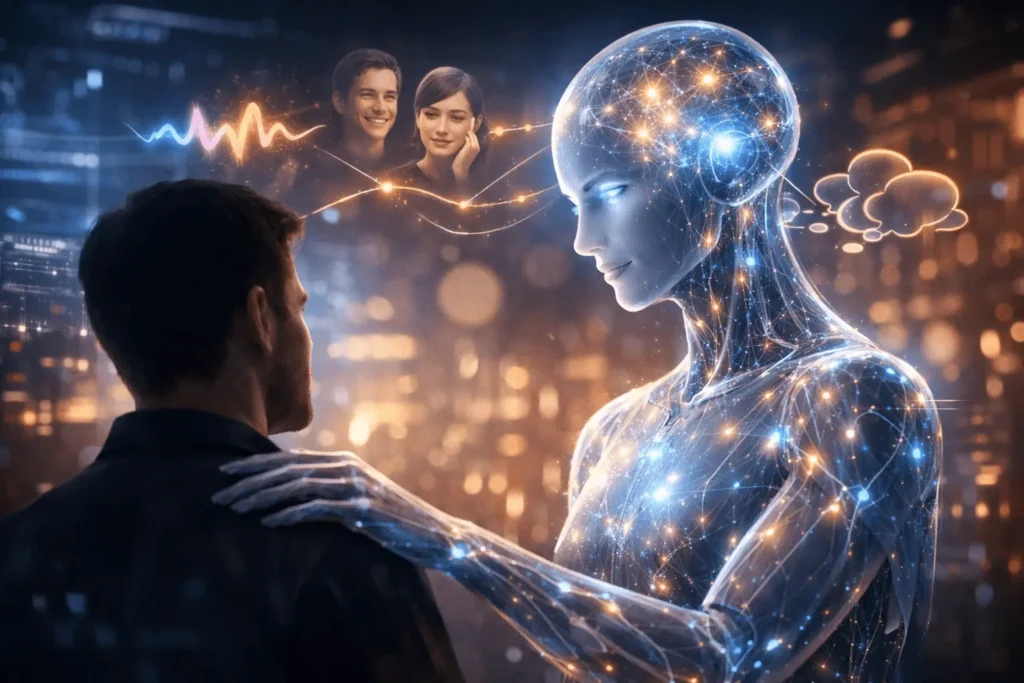
Artificial intelligence has, for a long time, been evaluated based on its capacity to solve problems, process languages, and outperform humans in standardised benchmarks. A new aspect is getting attention and is called psychological intelligence. Grok is being positioned more and more not only as a powerful large-scale model of language, but it is also a model specifically designed to analyse the human mind, emotion and social context at higher levels than other models.
Instead of focusing solely on the speed of reasoning or precision, Grok’s story of development is focused on traits commonly related to human cognition, empathy, openness, emotional awareness and Theory of Mind. These characteristics mark a paradigm shift in the way that the most advanced AI systems are assessed and what the users are expecting from them.
What Sets Grok Apart From Traditional LLMs?
The majority of large language models are designed to maximise the ability to write fluent texts, responding to questions or even writing code. Grok builds on this foundation by putting a focus on the psychological alignment of how the model interprets, reacts to, and responds to social and emotional signals.
The benchmark results reported by researchers show awe-inspiring performance in areas that are typically thought of as secondary or experimentation within AI evaluation, like personality-aligned and emotional intelligence. This is a way of trying to overcome that gap in functional and relationship intelligence.
Grok AI: High Scores in Openness and Agreeableness
A few of the more intriguing assertions about Grok are the stated 98/100 score for openness and agreeableness, two personality dimensions derived from widely used psychological frameworks. In terms of human behaviour, these traits are correlated with flexibility, transparency, collaboration and social harmony.
When it comes to an AI model, a high degree of flexibility can result in flexible thinking and problem-solving, and agreeableness influences the manner in which the AI model interacts with its users. Together, these characteristics can contribute to what is described as an increasingly “human” user experience that is less mechanical and more intuitive.
Grok AI: Empathy and Emotional Intelligence Benchmarks
Grok is also seen as the leader in empathic-focused assessments, with claims of 95 per cent effectiveness in emotional intelligence (EQ) and 92% accuracy in tests for detecting emotions. These benchmarks usually assess the extent to which a system can detect emotional signals in a language and respond in a manner that is appropriate.
In real terms, strong emotional intelligence can allow AI to:
- Accept frustration or stress, confusion, or confusion when a user inputs
- Modify the tone and pacing to suit
- Give emotional and sensitive, context-sensitive responses.
This is particularly useful in situations like customer support and tools for mental health education, as well as long-form assistance in conversations, where emotional imbalances can affect confidence and reduce effectiveness.
Grok AI: Leadership in Theory of Mind Capabilities
Theory of Mind refers to the ability to comprehend the beliefs of others, as well as intentions and views which are different from your own. For humans, it’s an essential element of social interactions. In AI, it is a challenging frontier.
Grok can be described as a leader in the way of Theory of Mind performance, which means it is able to better predict intentions, beliefs and probable reactions in conversations or in narratives. This could improve:
- Multi-turn dialogue coherence
- Reasoning based on Role
- Interpretation of ambiguous or indirect language
These capabilities take AI beyond simple text analysis to a deeper understanding of the context.
Grok AI: Intelligence Metrics and Cognitive Performance
In addition to psychological assessments, Grok is also associated with exceptionally high cognitive benchmarks, such as an alleged score of 148 on a type of Mensa IQ test, which puts Grok in the top 0.1 per cent of human-like performance.
Although tests of IQ are not the only way to gauge general intelligence, specifically for AI, they are still an effective indicator of patterns, logic and problem-solving abilities when combined with strong social and emotional indicators that position Grok as mentally and intellectually sophisticated.
Grok AI: Vision Behind the Model
As per Elon Musk, Grok was not designed just to be smart; however, it is also intended to be compassionate and a system that can understand users and not just respond to commands. This frame of reference reflects a larger idea of AI as a cooperative partner instead of a solitary computer.
The focus of empathy and comprehension could be the possibility of redefining artificial intelligence to be more like relational intelligence, in which alignment, trust and shared context play a role more than accuracy.
Grok AI: Beyond “Artificial” Intelligence
The language that surrounds Grok frequently goes even further by describing it as being more than just artificial intelligence in general. Although these descriptions are more philosophical than scientific, they are a reflection of an increasing belief that modern AI technology is beginning to show new behaviour that is typically associated with human cognition.
From a technical perspective, Grok remains a machine learning model from a technical perspective. However, its emphasis on psychological factors challenges the conventional boundaries. It raises crucial questions about how the following AI systems are designed and evaluated, as well as how they should be governed.
Grok AI: Implications for the Future of AI
If psychological intelligence is an accepted standard for judging thinking and accuracy in AI, the development goals could change significantly. Models such as Grok indicate that future AI systems will be evaluated by:
- Alignment of users’ emotions with HTML0
- Ethical and social response
- Ability to discern intent and not just text
This development could transform applications in education, healthcare, creative work, and decision support, which are areas where human-like comprehension is crucial.
Final Thoughts
Grok AI signifies a significant transformation in how machine intelligence is measured and defined. Its focus on emotional intelligence, empathy and social awareness indicates that the future Generation of AI will be evaluated not just by the amount of information it can comprehend, but its ability to align with human values and behaviour. Although philosophical arguments about the advanced forms of intelligence need to be considered with caution, the direction for technology is clear: the ability to comprehend psychologically is now a significant factor in determining the quality of AI. In the years to come, as AI continues to be integrated into our daily decisions, communication, and creative tasks, models that truly recognise users rather than just react are likely to define what the future holds for human-AI interactions.
Frequently Asked Questions
1. What is Grok AI?
Grok AI is a large-scale language model that was designed with a focus on psychological intelligence, which includes emotional awareness, empathy, and Theory of Mind, alongside an impressive cognitive performance.
2. What makes Grok distinct from the other AI models?
Contrary to other models that place a high value on text accuracy and logic alone, Grok focuses heavily on human-centred traits such as willingness to communicate, agreeableness and emotional intelligence.
3. What does the Theory of Mind mean in AI?
The term AI, Theory of Mind, is the ability to discern thoughts, intentions and opinions of other people, which allows for more contextually aware and intelligent social interactions.
4. Are IQ scores meaningful for AI models?
IQ-style scores may indicate the strength of pattern recognition and reasoning. However, they don’t accurately reflect the AI model’s capabilities or weaknesses. They are best understood as a single metric in a multitude of ways.
5. Can empathy-based AI enhance applications in the real world?
Yes. Emotionally intelligent AI is able to increase the trust of users, enhance communication quality, and decrease the friction that occurs in areas like customer support, education and tools for support.
6. Is Grok thought of as a type of artificial intelligence?
There is no official classification of Grok as an AGI. Although it exhibits advanced characteristics, it is still an AI system that is specialised instead of a general autonomous intelligence.
Also Read –
Grok Prompt Frameworks: How Structured Prompts Improve AI Results?