
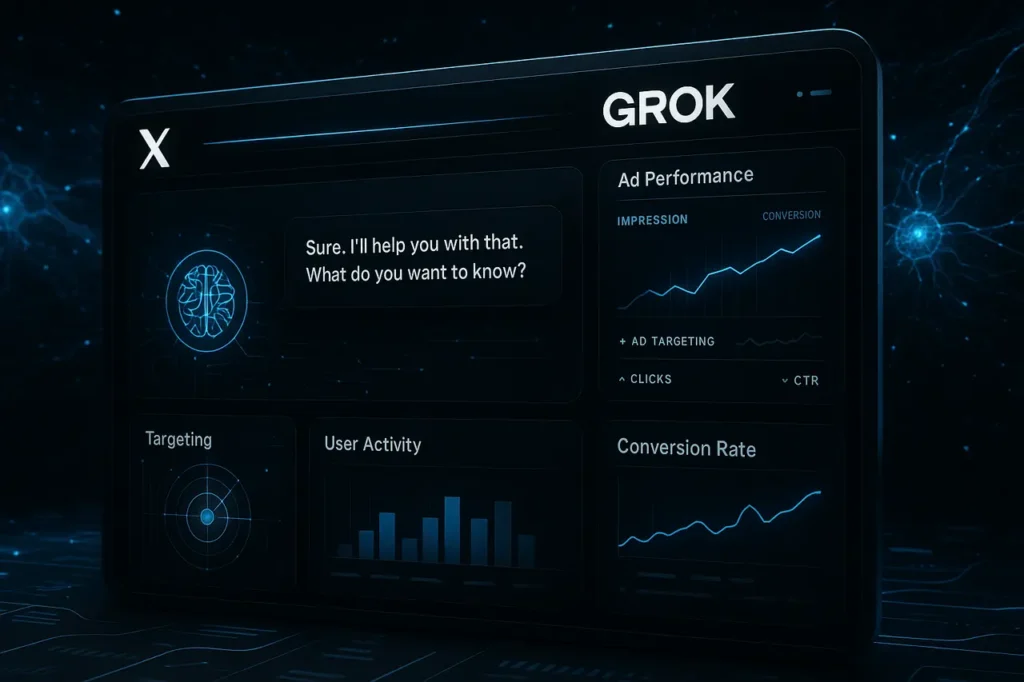
X, formerly Twitter, has recently begun marketing a brand new advertising proposition: ads powered by Grok. Grok, according to the pitch, “intelligently analyzes your posts, conversations, and interactions to deliver highly-targeted matches.” A widely shared social media posting echoed this pitch. It promises that advertisers can stretch their budgets further with ads targeted to users who are “genuinely interested and willing to engage.”
How accurate are these claims? And what do Grok powered X ads mean to marketers?
This article examines what we currently know, including the technology behind it, the new elements in X’s ad campaign, data from independent sources regarding X’s user base, and key considerations for advertisers and curious observers.
What is Grok?
- Grok, the AI assistant developed by xAI, is a powerful AI tool. It is available for users and integrated into X.
- xAI has acquired X in a 2025 stock deal. This acquisition combines X’s AI capabilities with a large user base.
- Grok has developed over the years. Versioning shows an increasing level of capability: Grok-2, for example, added advanced features such as “vision” (image comprehension) and a larger context window.
Grok, in short, is not a standalone app. It’s integrated deeply with X, and xAI has become the parent company. This integration is supposed to enable smarter, more context-aware social networking experiences.
What does “Grok powered X ads” mean?
According to X, the integration of Grok with its advertising system will mark a significant shift in how advertisements are created, targeted, and delivered. Here’s what’s new or newly highlighted:
- Automated Ad creation: Grok’s new system allows advertisers to enter their website URL, and Grok will generate ad copy and an image, along with a headline for their call-to-action (CTA). Advertisers can still manually edit the creative or replace it if they prefer.
- Ads in AI Answers: This is perhaps the most innovative — X intends to insert paid placements within the answers provided by Grok. This means that when a user asks Grok questions (e.g., “How can my small business ?”), incorporate SEO? “, the “suggested solutions” could include relevant adverts.
- More intelligent Targeting: xAI claims Grok’s understanding of users through their interactions, posts, and behaviour allows for a more precise ad match than the previous “random” ad targeting. They argue that this helps to ensure ads are delivered to people more likely to care and engage.
Ads become dynamic, context-sensitive, and potentially more efficient. This means marketers can expect lower waste of money and a higher return on their investment (ROI).
What we know (and what is still unknown) about What is?
The tweet that you mentioned claims that X “has 600M active monthly users, which surges to 1B at major events.” Let’s look at independent data.
- According to data from 2025 (early to mid), X will have around 557 million monthly active users.
- According to another source, the number of MAUs is 561 million (as at July 2025).
- Some counting variations and older statements (from inside X) refer to 600 million MAUs. However, independent trackers tend to converge on a range of 550-560 million.
- Estimates of daily users vary considerably. Some sources claim that there are 237,8 million daily active users (DAUs) worldwide.
- There is no publicly verifiable evidence to support this claim. Even though events can increase engagement, temporarily doubling or nearly doubling the number of active users would be a remarkable feat. No independent analysis has supported that number to date.
In Short: X remains a huge platform worldwide. The “600M MAU” figure may be an internal estimate. However, independent industry data suggest a slightly lower number. The “1 billion” figure is speculative and not verified.
Why are Advertisers particularly interested now?
Due to changes in ad models, brands – particularly premium brands and those seeking high-intent consumers- may find them attractive.
- Placements with high intent. Grok’s answers can deliver ads to users just as they are actively searching for solutions. This means these ads reach users when their attention is focused, and their intent is strong. This is similar to search or contextual advertising within a social setting.
- Grok can generate creatives, copy, and images automatically, so brands don’t have to design them manually. This reduces the workload for creatives, especially for small businesses or marketers with limited design resources.
- Grok’s analysis of user behaviour, rather than relying solely on demographics and static metadata, enables more precise targeting. This could allow brands to reach people who share similar interests, post about the same topics, or behave similarly. This could help optimize ad spending and boost conversion rates.
- Integration with social context. Ads can be integrated into a conversational AI environment within a social network. This fusion of conversational AI, social media, and advertising may provide a fresh approach to brand messaging.
These factors all combine to create a compelling value proposition. They allow you to reach engaged, high-intent users on a global platform while reducing manual overhead.
What challenges and uncertainties remain?
This model is not without its risks, and it leaves many questions unanswered—for both advertisers and observers.
- The effectiveness of AI ads has not been tested at scale. While the concept is appealing, it has yet to be proven at a large scale. No data on ROI or conversion rates for these placements is publicly available yet. Analysts warn that AI-driven ad placements alone may not be enough to solve the systemic problems with ad performance.
- Ads within conversational responses could be perceived as intrusive by users, depending on the way they are implemented. Some users may feel that integrating ads with AI-generated answers could reduce trust or even appear to be monetization.
- Ambiguity in user-demographic claims. The tweet’s claim that “users with the highest purchasing power” and 29% earn US$100K+ per year is unsubstantiated. There are no credible public statistics to support such a global distribution of income for X users. Marketers need to be cautious when making such demographic claims.
- Ad saturation and quality issues. Recent moves by X have revealed that the platform will enforce stricter “aesthetics” guidelines. Ads deemed “ugly”, “spammy,” or “unprofessional” may be suppressed, or they may charge higher rates. This means some auto-generated creatives could require manual refinement.
What Does This Mean for Brands & Advertisers?
This transition is both an opportunity and a dilemma for brands, from small to large businesses. Here are a few practical tips:
- Test early but test wisely: If you are running ads, try Grok’s copy generation, but be ready to review and refine the creatives manually. Monitor conversion and engagement closely. Start with small budgets.
- Context is essential: Advertisements within AI-generated answers are most effective for products and services that align with typical “help-seeking queries” (e.g., software tools, legal services, educational products, consumer goods). If you are selling luxury products or aspirational goods, your creative approach may need to be more considered.
- Do not rely on exaggerated claims: Ignore statistics that are too high, such as those about event surges or user income. These should only be used if they can be verified. Plan around conservative estimates, such as 550-560 million MAUs worldwide, and focus more on engagement and conversion than reach.
- Focus on brand safety and quality: Make sure that any visuals and copy you create meet the “aesthetic score” of your ad and are aligned with your brand values, both for the user experience and to ensure a long-term reputation.
Why is this shift significant? (Bigger Picture)
The decision to embed AI-powered ads inside a social media platform such as X is part of a larger convergence of advertising, content, and AI. If successful:
- As opposed to static banners and promoted posts, social media ads will start to resemble “answer-based suggestions” instead.
- AI-driven targeting may be more sophisticated—beyond simply demographics—by leveraging behavior, interests, and conversational context.
- As ad creation is more automated and less dependent on design teams, the entry barrier for smaller advertisers and businesses could be lowered.
- This raises questions about whether AI actually delivers the helpful content, or if it’s just a way for AI to monetize what appears to be assistance.
In essence, it could change the economics of social advertising and improve user experience.
Final Thoughts
Grok’s integration into X’s ad eco-system represents a bold move. X is trying to make advertising more intelligent, efficient, and contextually relevant by embedding ads within AI-generated responses and by using AI to customize ad copy and target the right audience. This could be a powerful way for advertisers to reach users who are engaged at critical moments.
Many of the most appealing claims, such as those about user income demographics and event-driven surges to 1 billion users or guaranteed high intent, remain unproven. The prudent approach for now is to view Grok-powered advertising as an experimental frontier. Test small, measure carefully, and don’t put your money on hype.
Frequently Asked Questions (FAQs)
1. Does Grok work for all X users?
Grok, the AI assistant of xAI, is embedded into X.
2. How many monthly active users does X currently have?
Independent data for 2025 places X’s monthly active user base around 557-561 million. The “600 million” figure is based on internal estimates and not independent verification.
3. What are ads in Grok responses?
X will insert ads directly into the AI’s response when a user asks Grok a question (e.g., seeking information or advice). The ad will appear in context with the question.
4. Are ads generated automatically possible?
The new system allows advertisers to submit a URL, and Grok will generate the ad copy and images. They can then accept or edit the output.
5. Are there any downsides or risks to this approach?
Yes. The effectiveness of Grok-powered ads has not yet been proven at scale; ad quality and brand safety are uncertain; user experience could suffer if ads feel intrusive; and some of X’s bold demographic and reach claims are not backed by publicly available evidence.