
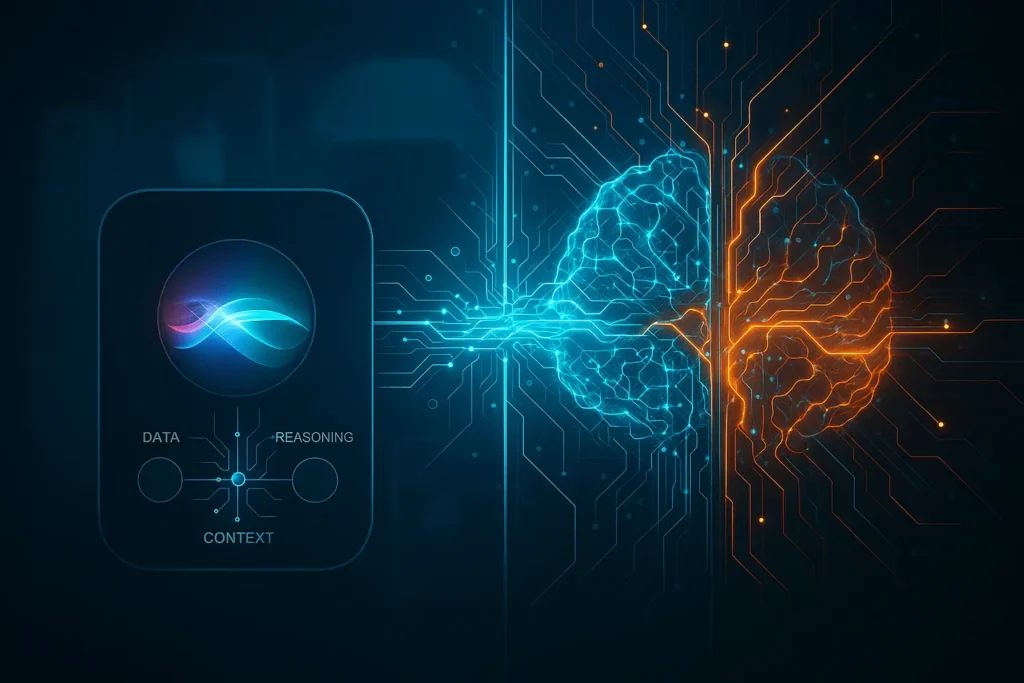
When Siri was first introduced on the iPhone in 2011, it was an event of a lifetime, integrating a voice assistant into one of the most beloved devices in the world. Now, in 2025, the majority of users are still dissatisfied with Siri’s shortcomings: a lack of clarity in the absence of context for each turn and an inability to handle more complex conversations or tasks. However, AI technology has exploded. In particular, xAI, the company founded by Elon Musk, has recently launched Grok 4.1, a quantum leap in conversational intelligence.
With these changes, an important question arises, Should Apple partner with xAI (or license Grok 4.1) and provide Siri the brain she needs? In this article, we will explore the benefits that Grok 4.1 provides, the reason Siri is in need of an upgrade and what a possible partnership would be like and what the risks and benefits could be — to give a complete overview of what this new technology could bring to Apple, as well as users, as AI in general. AI ecosystem.
What is Grok 4.1?
Grok 4.1 is the latest AI model created by xAI, designed to be faster, more precise, and more emotionally intelligent than previous versions. It is a leader in understanding complex sonification in real-time data processing and in creative tasks. Grok 4.1 significantly reduces hallucinations, offers more fluid conversation, and ranks among the top-performing AI models on the world leaderboards. It is, in simple terms, a sophisticated, human-like AI platform built to provide reliability and a profound understanding of context.
What is Siri?
Siri is Apple’s built-in virtual assistant, available on iPhones, iPads, Macs, Apple Watch, and other devices. It was launched in 2011. Siri lets users complete tasks with voice commands, like sending messages or setting reminders, browsing the internet, controlling smart-home devices, and even navigating iOS. Siri is a strict adherent to security standards and often runs tasks on the device, but it struggles with deep thinking, multi-step conversations, and modern AI tasks.
Why is This Important?
This topic is crucial since Siri is losing ground to the latest AI assistants, and users want natural conversations, accurate answers, contextual memory and advanced reasoning. These are features that assistants such as Grok 4.1, ChatGPT, and Gemini already have.
A possible cooperation between Apple and xAI could result in:
- Improve Siri’s intelligence and effectiveness dramatically
- Eliminate the gap, Apple as well as AI leaders
- Provide a next-generation assistant who is aware of context and can communicate naturally
- Expand Apple’s ecosystem through intelligent automation and personalised services
- Provide millions of users with an incredibly powerful everyday assistant
In the simplest terms, combining Siri’s ecosystem with Grok 4.1’s capabilities could transform the future of the digital assistant, creating devices that are more user-friendly and responsive. They can also be genuinely useful.
Grok 4.1 fix Siri: The Reason Siri Requires Help
Despite being part of Apple’s ecosystem and boasting solid security and hardware features, Siri continues to lag behind other AI assistants. Important points:
- The reports suggest that Apple’s AI infrastructure is top-of-the-line and that improving Siri and its internal models is a top priority for 2025.
- There is a persistent rumour that Apple is developing generative AI capabilities for Siri (e.g., complete conversational capability, a “creation service” for iOS, cross-device contextual capabilities) with a timeframe of spring 2026.
- A leak in the industry suggested that Apple was looking to license a large AI model (reportedly from Google DeepMind) with ~1.2 trillion parameters to power Siri, at an estimated cost of $10 billion per year.
- Siri’s perceived weaknesses:
- Inadequate memory/context across follow-up questions
- More complex multi-step reasoning, or imaginative responses
- The use of tools is limited compared to the most cutting-edge models.
- Apple’s strict privacy policies and restrictions on processing devices slow the pace of technological innovation.
In a nutshell, Apple has great hardware, control over its ecosystem, and privacy branding. However, bringing top conversational AI models in-house is an enormous task. Hence, the appeal of partnering/licensing.
What a partnership between Apple and AI could Be Like
If Apple decides to adopt Grok 4.1 (or a variant) to replace Siri, the following rough design and roadmap could apply:
- Hybrid Model Architecture
- Create a light on-device assistant that can be used for specific tasks (e.g. offline devices and device control, or low-latency replies)
- More complex queries can be routed (reasoning lengthy conversations, reasoning Third-party integrations) to the Grok 4.1-class backend hosted by xAI. It can also be jointly hosted.
- Apple will retain privacy decisions, e.g., selecting the method for sending query data off-device.
- Data & Privacy Safeguards
- Apple insists on strict privacy. It requires minimal data logging, anonymisation, and pre-filtering on devices, with a Moderation pipeline controlled by Apple.
- Contractual commitment by xAI concerning training and use of Apple user information.
- Branding & User Experience
- The user is only able to experience “Siri enhanced” The branding is Apple’s.
- Apple could market “Siri powered by Grok 4.1” or keep the model transparent only to developers/tech-savvy users.
- Safety, Moderation & Reliability
- Apple should add strong security measures. xAI has been a source of some controversy over the years (for instance, the older Grok versions that generated undesirable outputs in the public).
- Apple will perform an independent assessment of the model’s behaviour, security, bias, and metadata.
- Phased Rollout and User Choice
- Pilots in restricted geographies or users in a specific segment.
- Provide an opt-in option to “advanced Siri” powered by Grok.
- Monitor performance, latency, reliability, data usage, and satisfaction.
Grok 4.1 fix Siri: Benefits and Risks
Benefits
- Advance in capabilities: Siri would gain advanced conversational capabilities within a day (compared to starting from scratch).
- Competitive advantage: With competitors such as ChatGPT-enabled assistants and Google’s Gemini entering the market, Apple would regain momentum.
- A user-friendly experience: A better understanding of the context, fewer errors due to factual as well as a more enjoyable conversation could increase the value of Siri and improve its user perception.
Risks
- Privacy and Trust: When data from users or their inferences is transferred to systems outside Apple’s, the reputable brand could be damaged.
- Branding and control: Handing over the “brain” that is Siri to an outside company reduces the value Apple offers from end to end.
- Legal and safety risk: Any model output that goes wrong could reflect on Apple — xAI/Grok has seen previous public controversy.
- Costs and commercial terms: Licensing this model could be very costly (recall the $10 billion annual leak in Google modelling licensing).
- Dependence and lock-in: If Apple becomes dependent on an external model, it might lose its internal strategic flexibility.
What does this mean for users?
If you are a person who uses the internet (whether within India or across the globe):
- We can expect to see a far more efficient Siri in the coming iOS and macOS updates: more conversations, more memory, more effective follow-up and more natural.
- It’s possible to “feel” like you’re using Apple’s assistant (no significant UI shift); however, under the hood, it could be powered by a different engine.
- Privacy will be a significant selling point. Apple will likely emphasise this feature heavily when using the external models.
- For Apple customers, Siri, which actually functions as an intelligent assistant (not just a voice assistant), can enhance the value of the Apple ecosystem.
- For Indian users, Support for regional languages and context-aware responses, as well as Integration with Indian services, can be enhanced more quickly when Apple speeds up through third-party models.
A New Future: What Will Happen If Apple Adopts Grok 4.1?
It is predicted that the future of AI assistants is shifting away from basic voice-based commands toward intelligent interaction. If Apple were to join forces with xAI or adopt Grok 4.1, the coming years could completely change the face of assistants.
1. Siri Transforms into a Conversational
Future Siri versions may hold lengthy, intelligent conversations in the same way current AI models do, storing context, emphasising emotions, and providing more thorough analysis rather than simple, single-line responses.
2. A Hybrid On-Device + Cloud Intelligence
Apple is a household name for the privacy it offers. The future of Apple is likely to be a hybrid system:
- The models on devices handle private tasks, such as messages, reminders, and shortcuts, as well as personal information.
- Cloud Grok’s level of intelligence can handle reasoning, creativity, and long-term tasks. Difficult questions.
This will provide users with speed, privacy, and intelligence simultaneously.
3. Smarter Automation across the Apple Ecosystem
An updated Siri, particularly one similar to Grok 4.1, can automate all workflows across iPhone, Mac, iPad, Vision Pro, and HomePod.
Examples:
- Auto-editing documents
- Generating content
- Scheduling and planning across applications
- Multi-step tasks such as scheduling travel or business workflows
The assistant is not reactive; the assistant is active.
4. A More Competitive Apple
At the moment, Google (Gemini), OpenAI (ChatGPT), and xAI (Grok) are several years behind Siri in generative intelligence. If Apple doesn’t move quickly, it could fall behind in the most significant technology shift since smartphones.
Incorporating or partnering with Grok 4.1-level intelligence may quickly reduce the gap.
5. Expectations for Users to Change
The public will expect assistants to think, reason, summarise, or create content, and to tackle real-world problems, not just respond to requests such as “set an alarm.”
The future lies with assistants that serve as smart, intelligent digital partners.
6. Ethical, Safe and Privacy Evolution
As assistants grow stronger, Apple must establish new standards for:
- Guardrails
- Transparency
- Protection of data
- Use of AI in a responsible manner
If they are done correctly, Apple could define the gold standard for consumer security.
7. A Future Era for AI-related Partnerships
The future could bring Apple working with other companies, not just xAI, but also with
- Google (Gemini)
- OpenAI
- Anthropic
- Other frontier labs
Smartphones were all about technology.
The next era is all about intelligence.
Final Thoughts
The tweet’s message is “It’s the right time for Apple to join forces with xAI to actually solve the problem with Siri and replace that old, annoying, clunky Siri with Grok 4.1 The Grok 4.1 version of Siri should be Superintelligent. Grok 4.1 is ready today. Grok 4.1 is out today” — captures an instinctive desire: Siri should feel modern and intelligent, as well as friendly. In many ways, Grok 4.1 is up and running. The technical box has been examined. The main issue is whether Apple will be willing to change its assistant architecture and work with external partners while navigating the legal, commercial, privacy, and brand-related complexities.
If Apple succeeds in this, we could witness the arrival of a Siri that feels “smart” like those assistants are supposed to. If they don’t or aren’t quick enough, the gap between Siri and the other AI world will only get bigger. For those who use Siri, the expectation is evident: that Siri is evolving from a “voice command tool” into a real dialogue partner.
FAQs
1. Is Grok 4.1 available right now?
Yes. xAI announced the launch of Grok 4.1 on November 20, 2025. They made it accessible to users via grok.com and a mobile app.
2. Is it true that Apple stated that it will be using Grok or license the model of xAI?
No official announcement has been made regarding a possible deal with xAI. But Apple has publicly prioritised upgrading Siri and has also reportedly considered licensing large-scale models (including Google’s).
3. Does the use of Grok mean that Apple compromises the privacy of its users?
Not necessarily; it depends on how it is implemented. Apple must enforce strict data governance when routing data queries via an external data model. Apple’s privacy branding is a significant problem and obstacle.
4. Is Siri currently utilising the power of generative AI?
Apple is currently working on generative AI improvements for Siri (and other system applications) and hopes to launch major updates in Spring 2026.
5. What happens if Apple does not join forces with xAI? What are other options?
Apple could develop its own large model (but it is costly and time-consuming) or license one from another (e.g., Google’s Gemini, Microsoft/OpenAI, and others). Each option comes with trade-offs in terms of costs, control, and speed to market.